

Best WiFi 7 Access Point Performance – MBReviews Leave a comment
It’s pretty frequent to first launch the higher outfitted machine, as a type of energy show, so the Zyxel WBE660S that you simply see right here is essentially the most highly effective WiFi 7 entry level from Zyxel (in the meanwhile of the writing) and sure, it has been launched a couple of months earlier than the NWA130BE. The latter did have to attend a couple of months till it acquired the assist for MLO, whereas the WBE660S had it from the start.
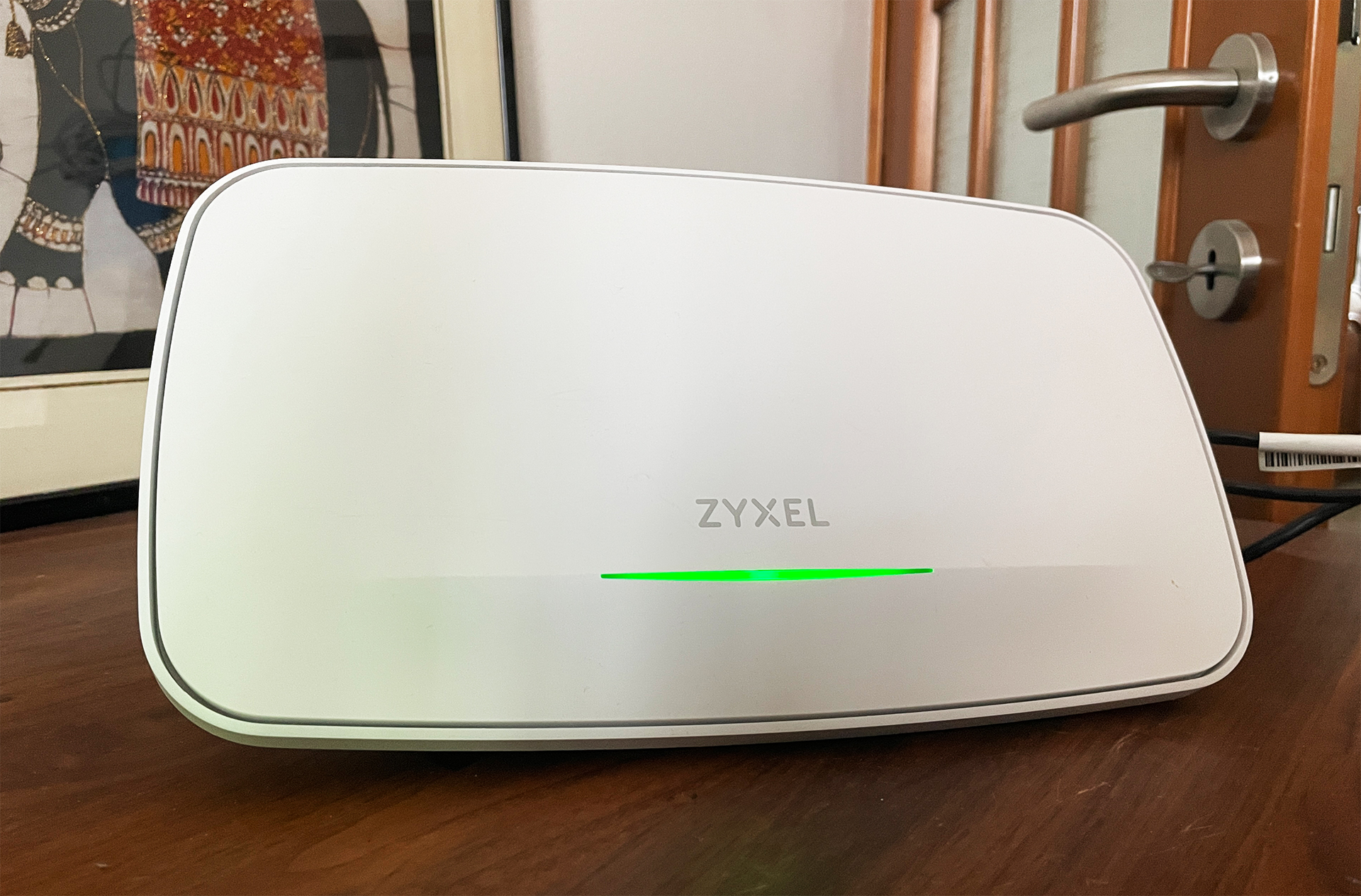
Which is good, however the consumer {hardware} additionally wanted to catch up and it wasn’t till the autumn of final 12 months that we lastly bought a extra steady efficiency with each Windows and Linux. That being stated, the Zyxel WBE660S is a better of a tool and never essentially by way of measurement, however weight and robustness. I used to be positive that it may very well be mounted outside, however there isn’t any IP ranking, so mount it out by yourself danger. The entry level comes with two ports, one Gigabit, the opposite 10GbE which is a big step up from the two.5GbE port for the NWA130BE.
The antenna achieve can be higher on the WBE660S and the spatial streams are 4×4 on all three radio bands. Other than that, we do get a sensible antennas as soon as once more, and, by way of software program administration, there may be not solely the choice to make use of the Nebula Cloud, however a controller and the choice to make use of the entry level in standalone mode as properly. That being stated, let’s see the WBE660S in motion.
The Design and Build Quality
The Zyxel WBE660S is unquestionably bigger than the WBE660S, however not by that a lot, and this new design that we see with their entry level may be very good truly. It’s positively helps differentiating the Zyxel entry factors from the remaining. The higher facet is manufactured from plastic, whereas the rear is metallic for a greater warmth administration.
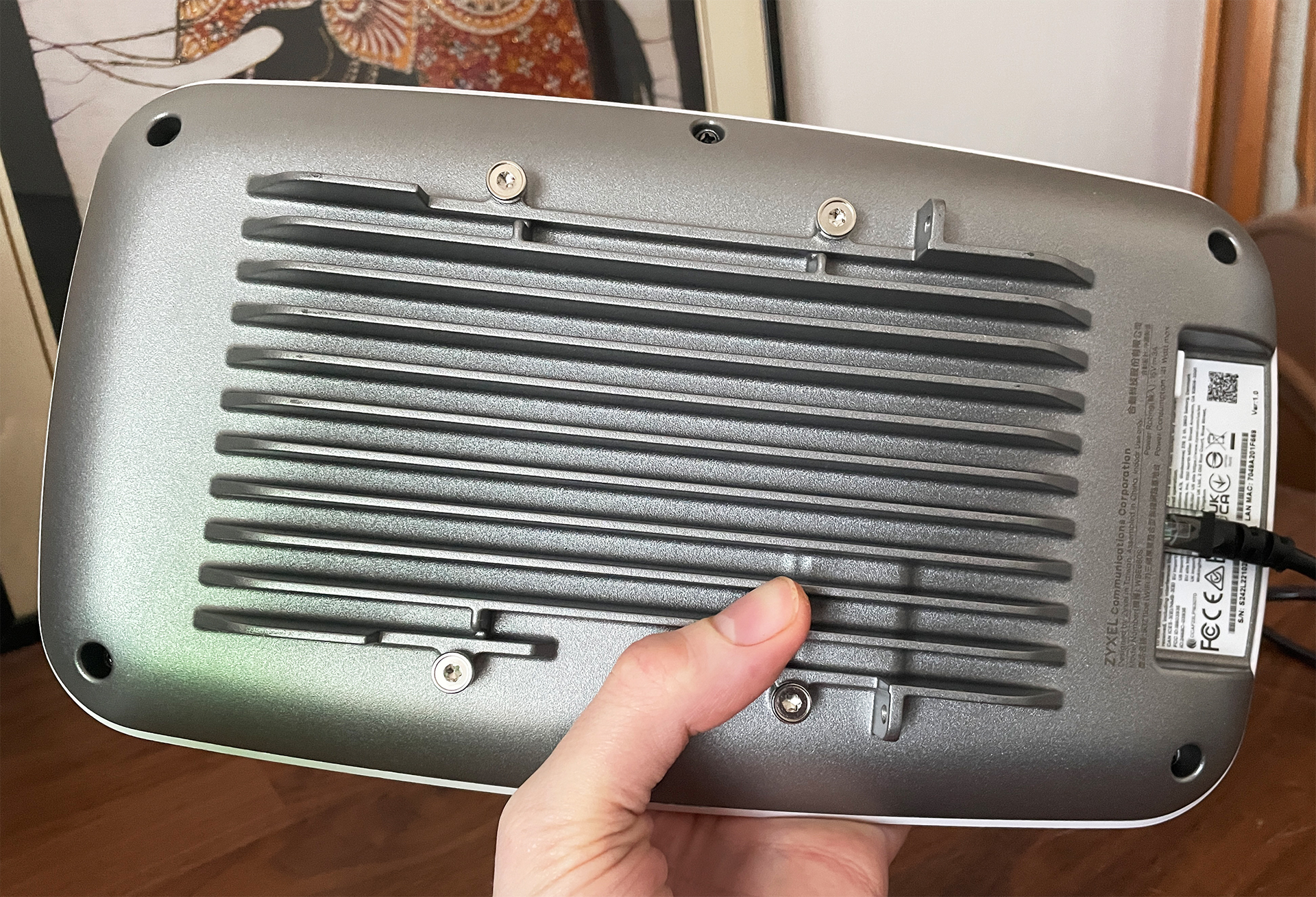
The NWA130BE went with an all-plastic case, nevertheless it was specifically designed to assist dissipate the warmth as properly, so it’s not atypical plastic. The single LED sits on the high similarly to the NWA130BE which at this level, may be thought-about a miniature WBE660S. And it does operate in the identical means, with flashing inexperienced, blue and crimson. Far from intuitive, however know that inexperienced and blue is nice, whereas crimson not a lot.
Flip it the other way up and we get to see the intricately-designed metallic backside and, since we’re coping with a ceiling-mount entry level, it does include a bracket. Also, it’s higher to not go away the WBE660S on the desk. It will fall off simply and that is no cheap machine. As for the ports, we do get fairly a couple of surprises right here.
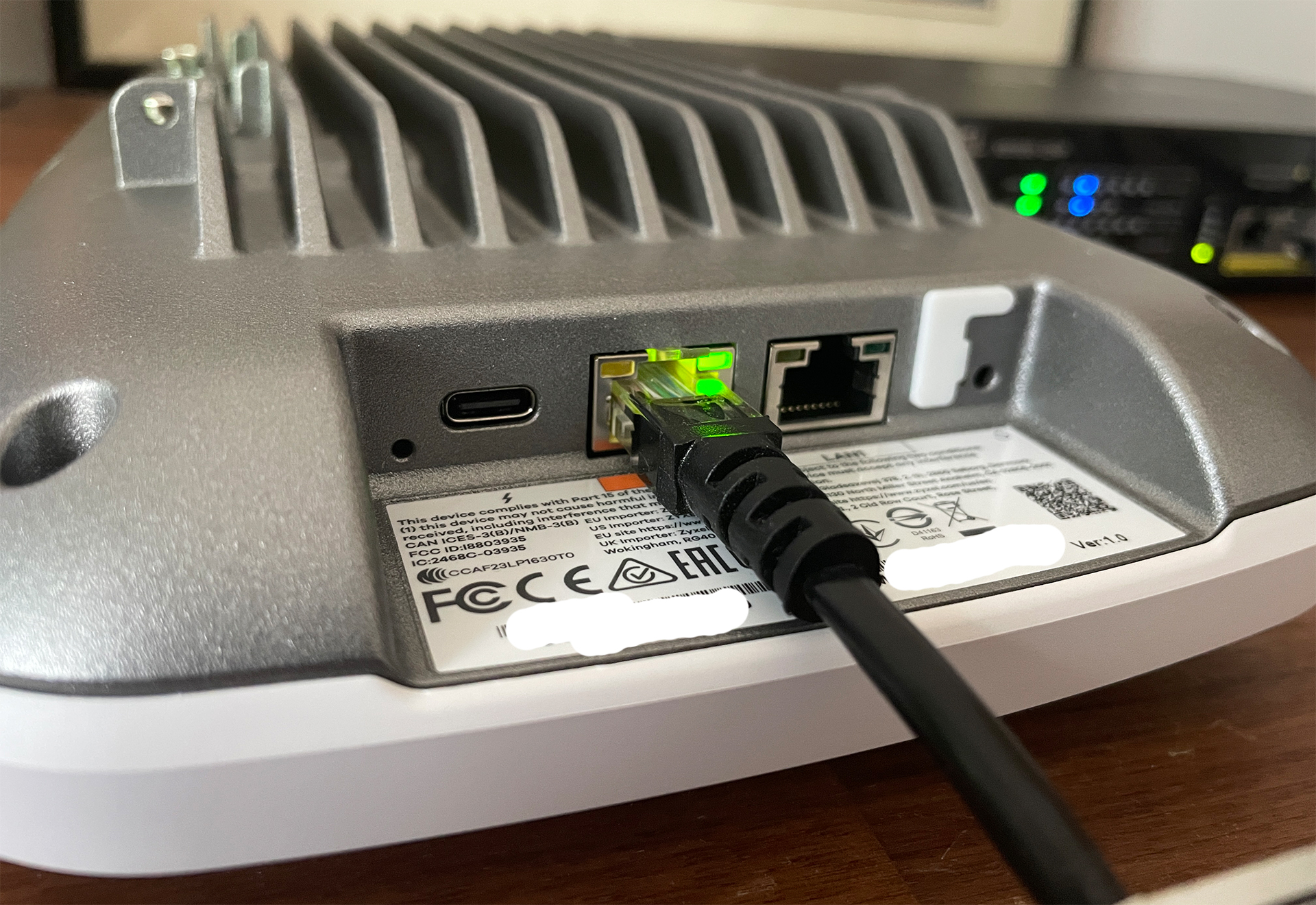
On one hand, there are two Ethernet ports, one is Gigabit, the opposite can go as much as 10GbE which is good news contemplating that this can be a WiFi 7 entry level. On the opposite hand, we get a USB-C port for charging if PoE(++) is just not accessible which is a novel function on networking {hardware}. There can be a Console port and a Reset button.
The Thermal Management
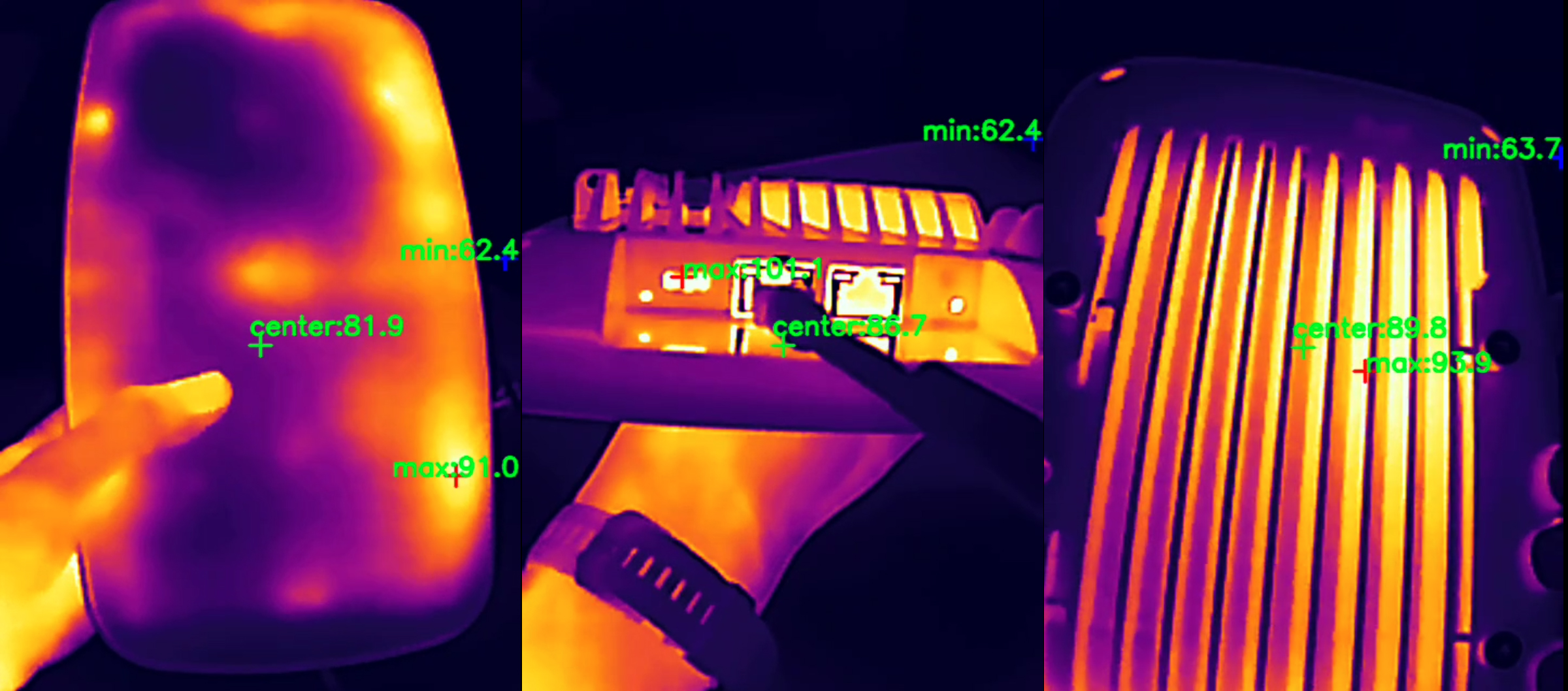
While Ubiquiti went the bizarre route of including a fan to chill down the case of their WiFi 7 entry factors, Zyxel stored the tried technique of transferring the warmth away from the parts utilizing warmth spreaders and a half of the metallic case. Did it work? It did and, as you possibly can see, it labored higher than anticipated.
Zyxel WBE660S Teardown
Now that we’ve reached the teardown part, know that I did open the entry level a few months again and I did a devoted video the place I am going much more in-depth on the method of opening the machine. Then once more, Zyxel makes issues easy as at all times, requiring the removing of 4 screws and sure, there isn’t any guarantee seal. Why would there be one? And we rapidly get view of the PCB.
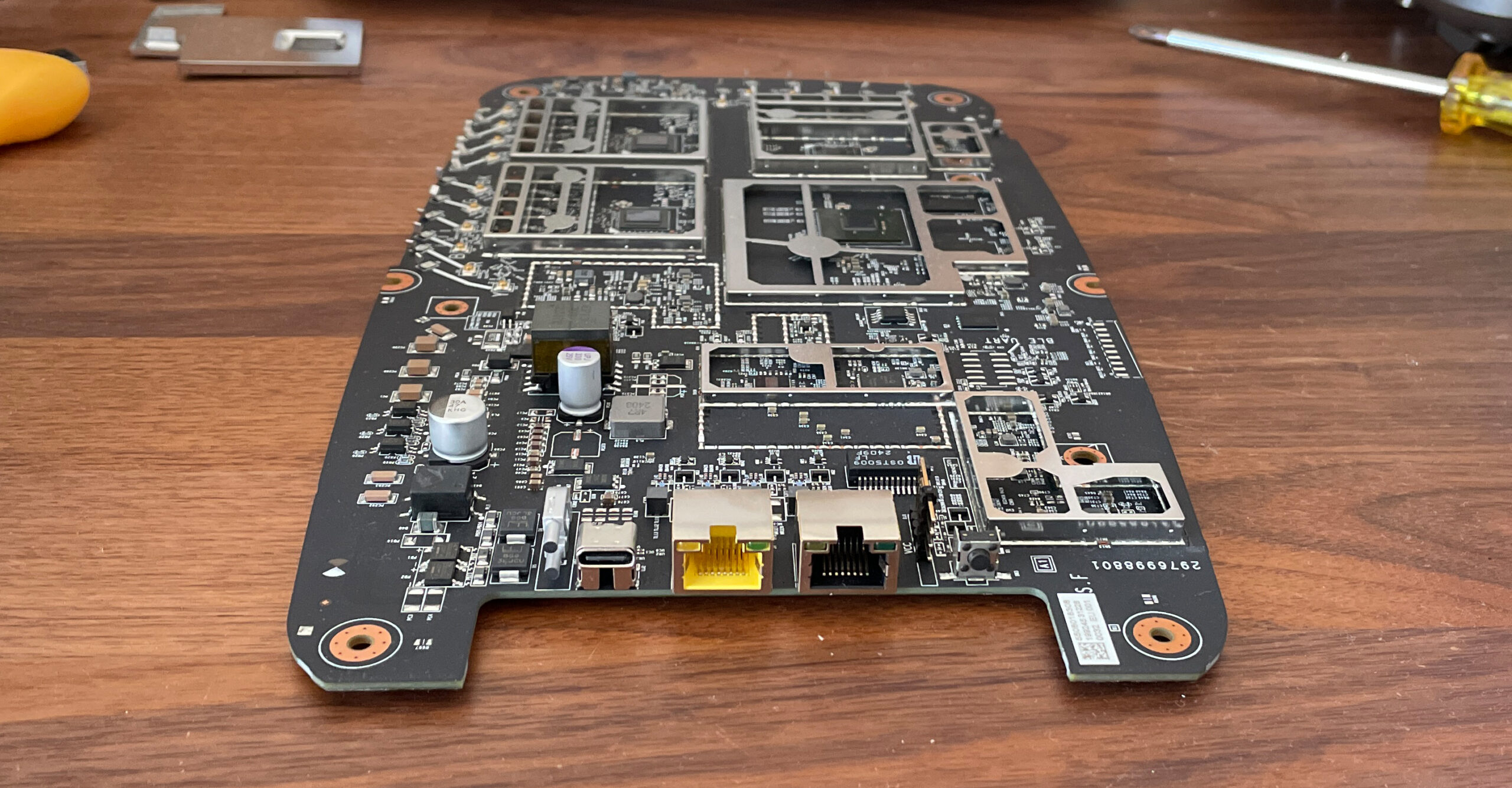
The major parts are beneath the aluminum covers, however earlier than that we have to see this good antenna that Zyxel has proudly introduced it has used with the WBE660S, which, identical to on the NWA130BE, it does embrace an RF filter. To attain the 2 antenna plates, you’ll have to first detach a metallic warmth spreader and, earlier than that, to rigorously disconnect all of the antennas from the board. They are not any soldered, so it’s straightforward to take action. I’ve additionally included a comparability desk with different WiFi 7 entry factors that I’ve examined thus far.
Hardware Comparison
| Zyxel WBE660S | Ubiquiti U7 Pro Max | Zyxel NWA130BE | EnGenius ECW536 | |
| CPU | quad-core 2.2GHz Qualcomm IPQ9579 (A73) | quad-core 1.5GHz Qualcomm IPQ5322 | quad-core 1.5GHz Qualcomm IPQ5322 (Cortex-A53) | quad-core 2.2GHz Qualcomm IPQ9570 (A73) |
| RAM | 2GB Nanya NT5AD512M16C4 | 1GB Samsung (SEC K4A8G16 SYC 8CTD) | 1GB Micron 3UR77 D8BPK (DDR4) | 2GB (2x Nanya NT5AD512M16C4-HRI) |
| Storage | 256MB MXIC MX35UF20E4AD | 4GB Kingston EMMC04G-MT32 | 512MB (MXIC X233662 MX35UF46E4AD-241)/ 16MB NOR flash (MXIC MX25U12832F) | 512MB NAND (MXIC MX35UF4GE4AD) |
| Switch | Marvell AQrate GEN4 Ethernet PHY | Qualcomm QCA8081 Ethernet PHY | Qualcomm QCA8385 Ethernet PHY | 2x RealTek RTL8261N N2068H3 |
| 6GHz Radio | Qualcomm QCN6274 802.11a/n/ac/ax/be 4×4:4 | Qualcomm QCN6274 802.11be 2×2:2 | Qualcomm QCN6274 802.11be 2×2:2 | Qualcomm QCN6274 802.11be 4×4:4/td> |
| 5GHz Radio | Qualcomm QCN6274 802.11a/n/ac/ax/be 4×4:4 | Qualcomm QCN6274 802.11be 4×4:4 | Qualcomm QCN6274 802.11be 2×2:2 | Qualcomm QCN6224 802.11a/n/ac/ax 4×4 4×4:4 |
| 2.4GHz Radio | Qualcomm QCN6214 802.11b/g/n/ax 4×4:4 | Qualcomm QCN6274 802.11b/g/n/ax 2×2:2 | Qualcomm IPQ5322 802.11b/g/n/ax 2×2:2 | Qualcomm QCN6214 802.11b/g/n/ax 4×4:4 |
Single Client Tests (6GHz & 5GHz)
Before stepping into the extra difficult exams, let’s first check out the extra primary single-client exams. And, as I did with the U7 Pro, the Zyxel NWE130BE and plenty of extra different WiFi9 7 entry factors, I relied on a number of varieties of consumer gadgets starting from the higher-end WiFi 7 to the nonetheless frequent WiFi 5 gadgets.
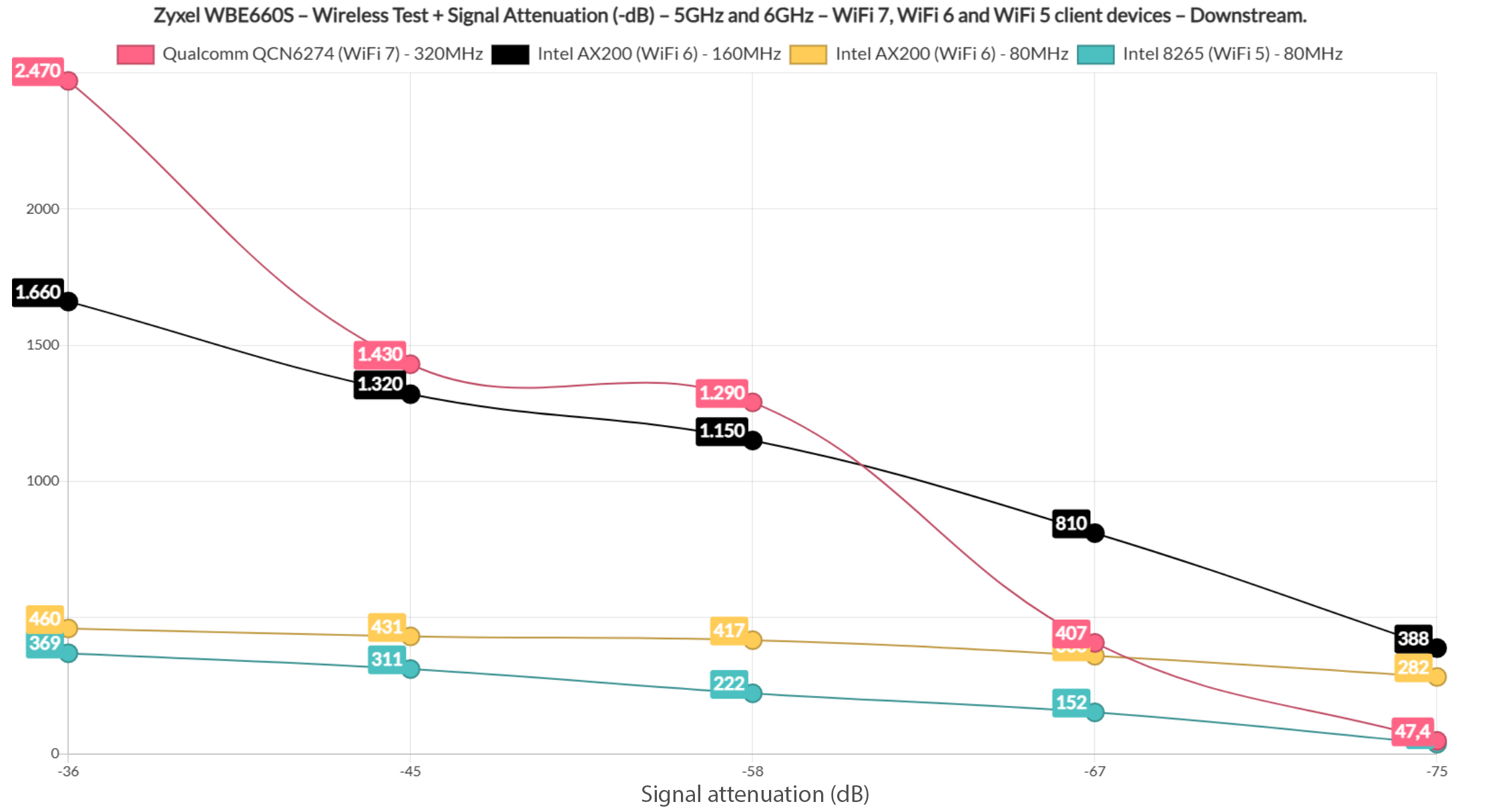
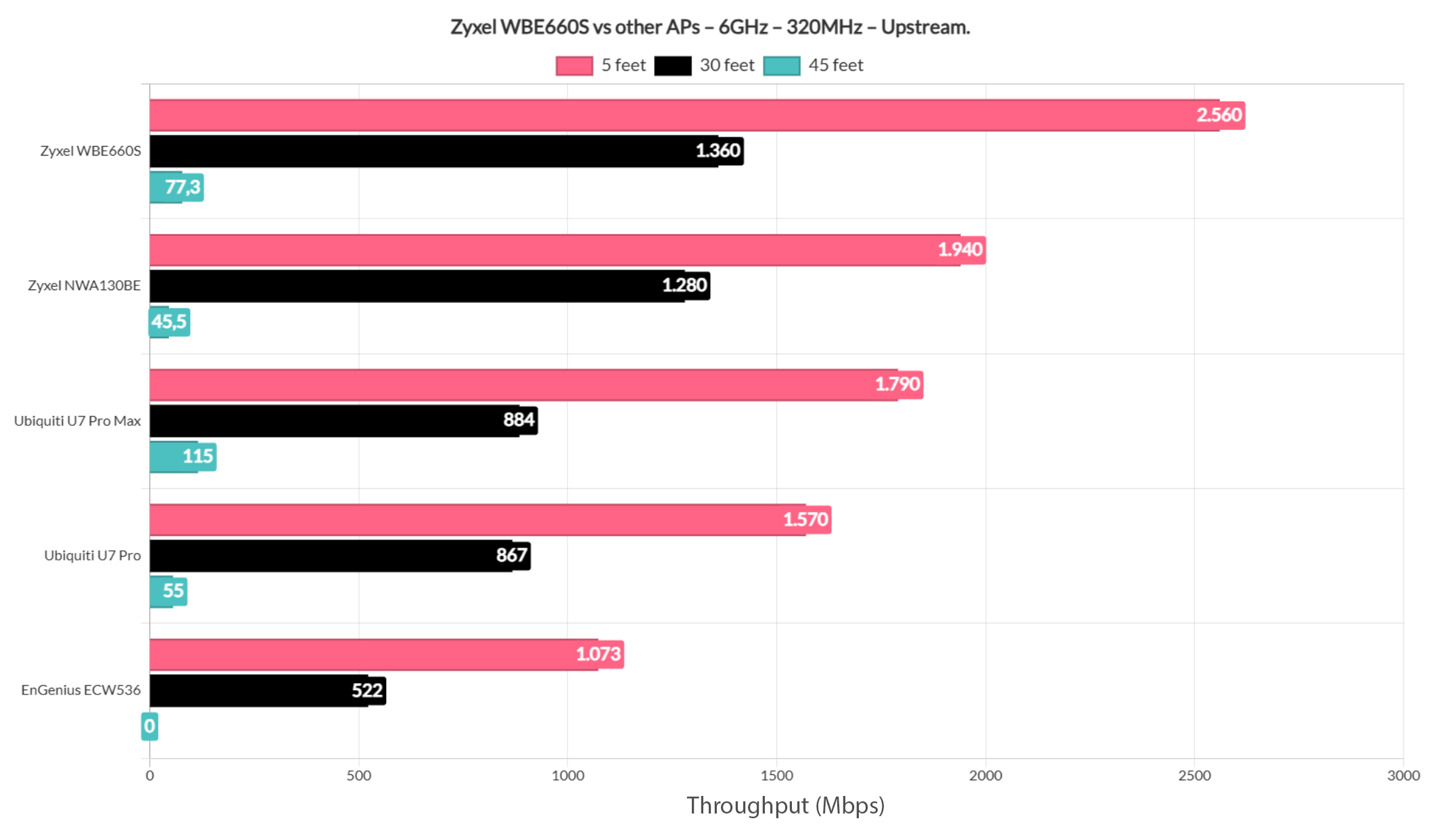
I do have a number of WiFi 7 adapters accessible, however I choose the MSI Herald-BE, whereas the WiFi 7 consumer is an Intel AX200 and the WiFi 5 is an Intel 8265. And the outcomes are spectacular, the WBE660S managing to outclass all the opposite WiFi 7 entry factors that I examined, going above 2.5Gbps when close to the consumer and nonetheless sustaining above 1.3Gbps charges at 30 toes.
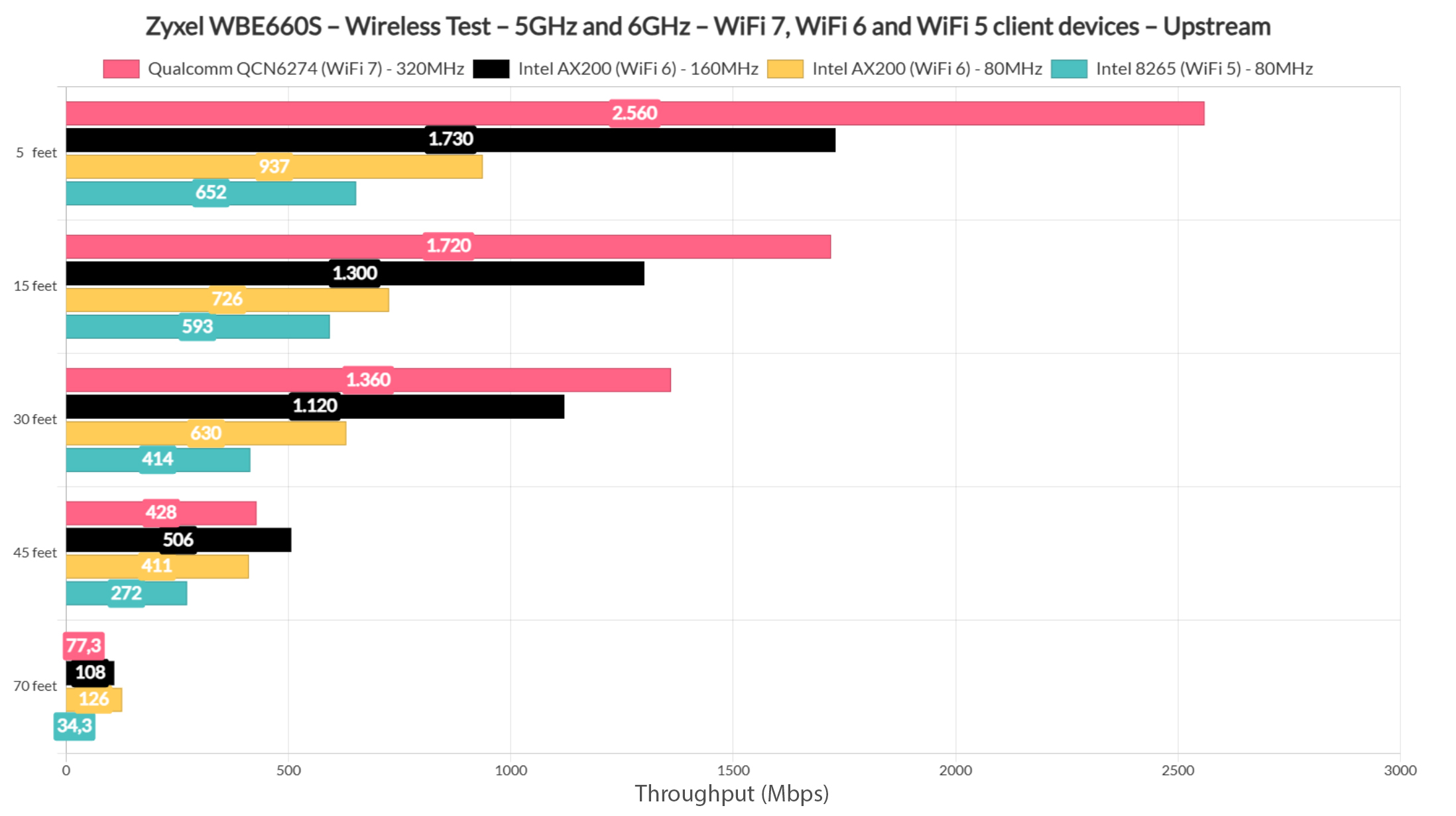
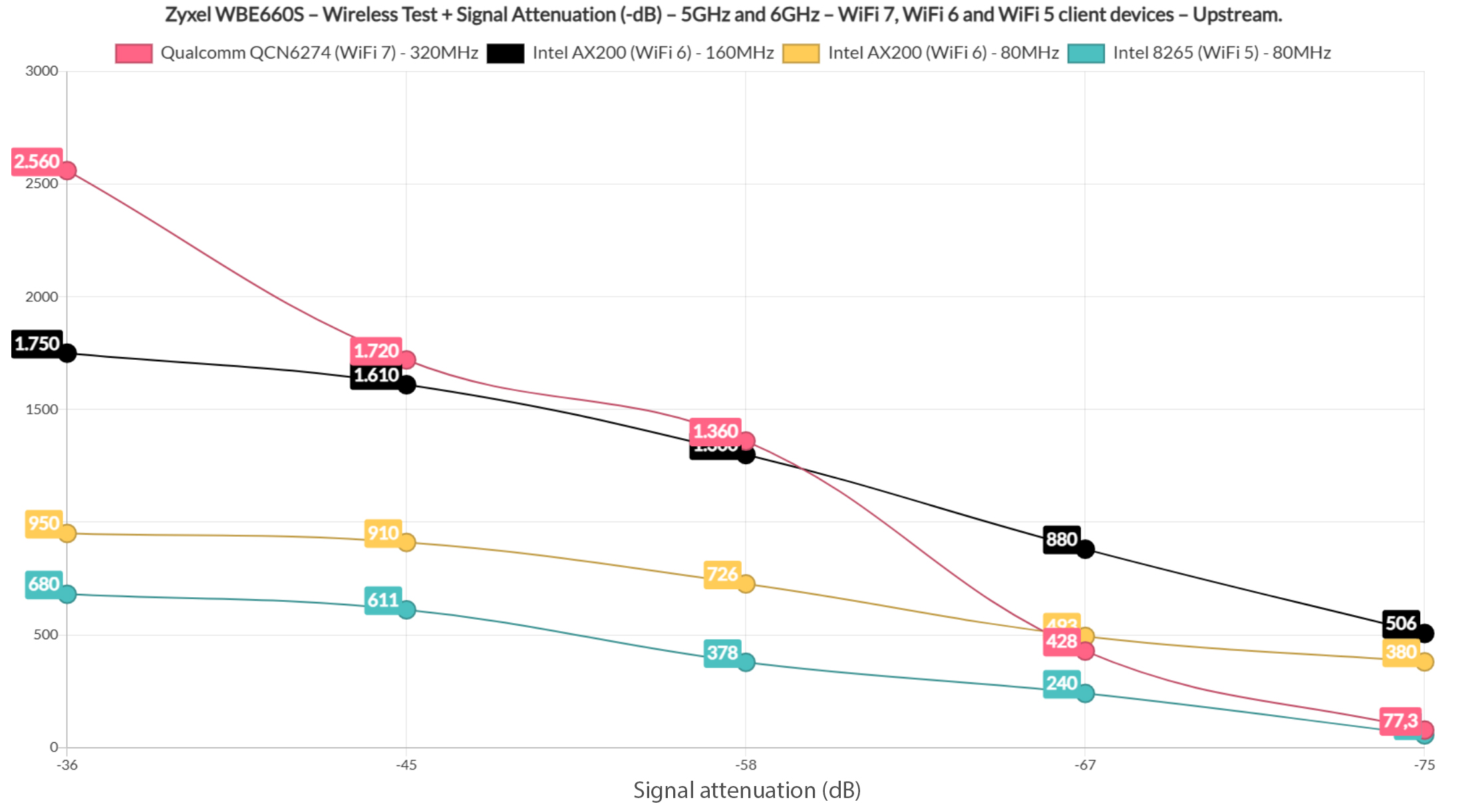
At 70 toes, we see that it drops beneath 100Mbps, and, after checking the sign attenuation graphic, we perceive why the WiFi 6 consumer did a lot better by way of vary.
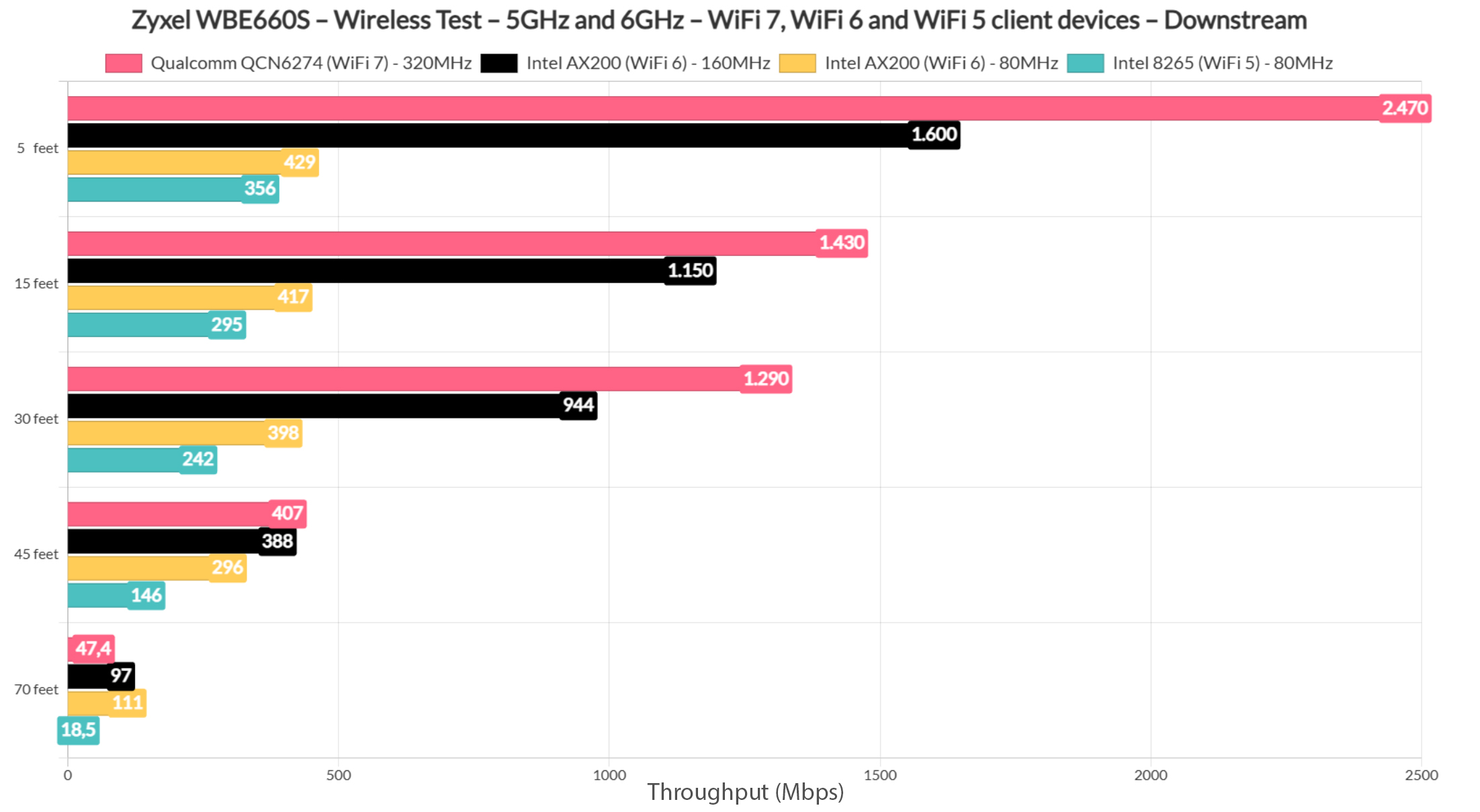
This is all upstream, so let’s take a look on the downstream graphics. And you possibly can see instantly that it’s solely barely worse than upstream, whereas final 12 months, after testing the U7 Pro, the Pro Max, the ECW335 and the NWE130BE, the outcomes have been nowhere close to this good.
Things can get even higher as you’ll quickly see with the MLO enabled. But earlier than that allow’s take a look at how the WBE660S fares towards different entry factors when utilizing the 80MHz channel and 5GHz.
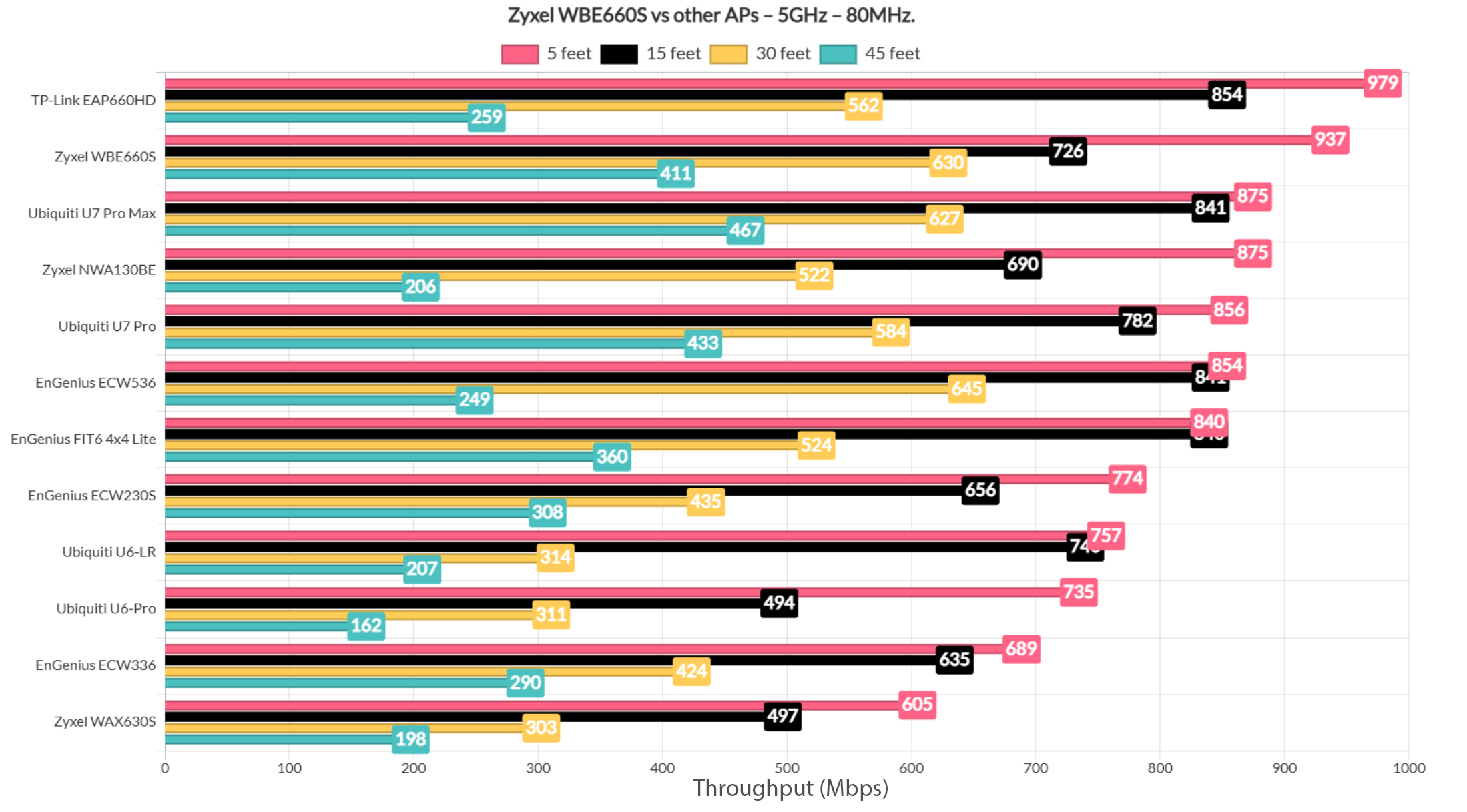
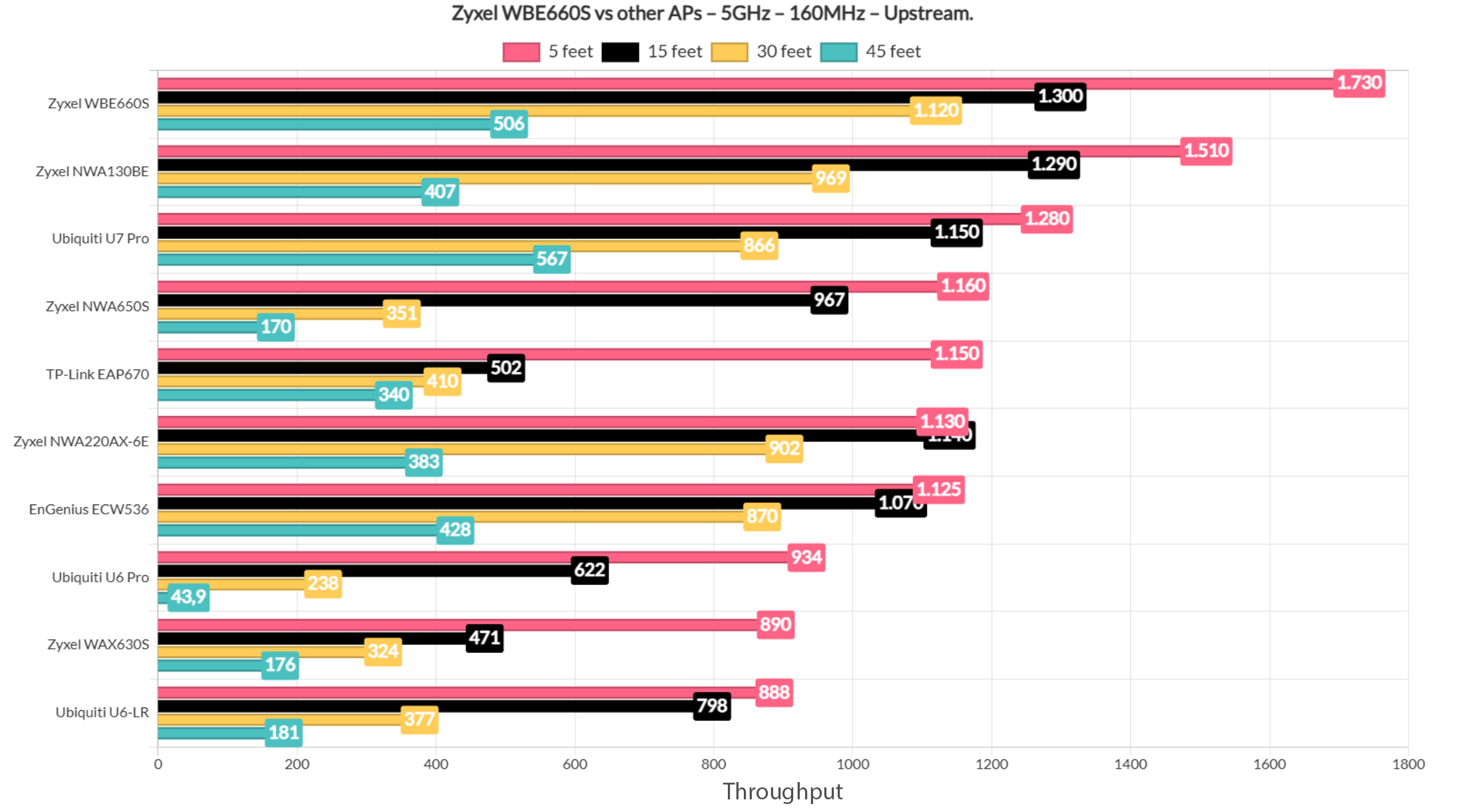
Still inferior to the TP-Link EAP660HD, however nonetheless second. And it did take first spot when utilizing the 160MHz channel bandwidth.
Switching to 6GHz and 320MHz, the Zyxel WBE660S as soon as once more takes first spot.
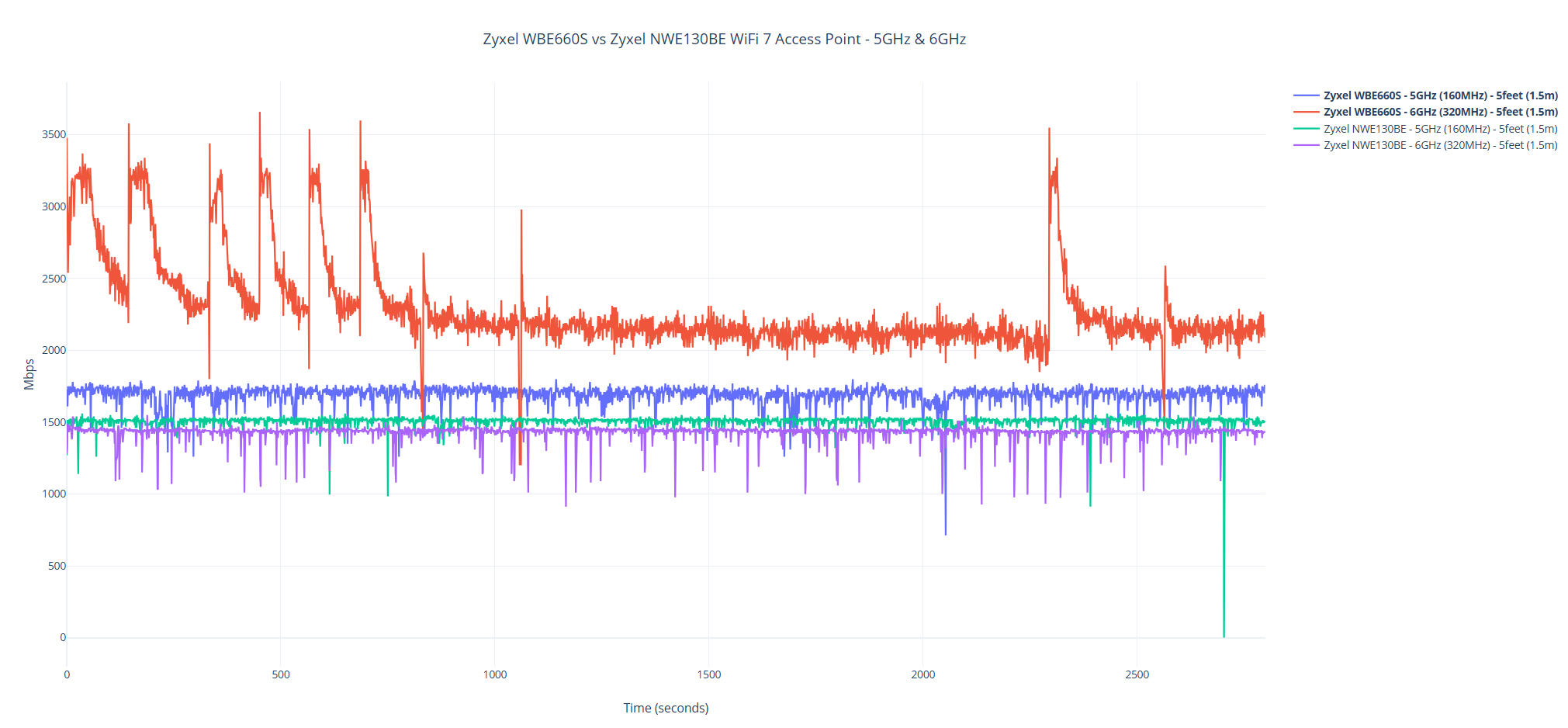
I’ve additionally added a longer-term graph to see the fluctuations that you would be able to anticipate in respect to a different Zyxel entry factors. And there are some attention-grabbing patterns, clearly in relation to the {hardware} I used to be utilizing.
Single Client Tests (2.4GHz)
Moving on to the two.4GHz radio band efficiency, I did take away the Pixel 2 XL because it carried out badly and I didn’t actually discovered a alternative for it. Anyway, we nonetheless get an concept about what to anticipate when utilizing WiFi 6 and WiFi 5 consumer gadgets.
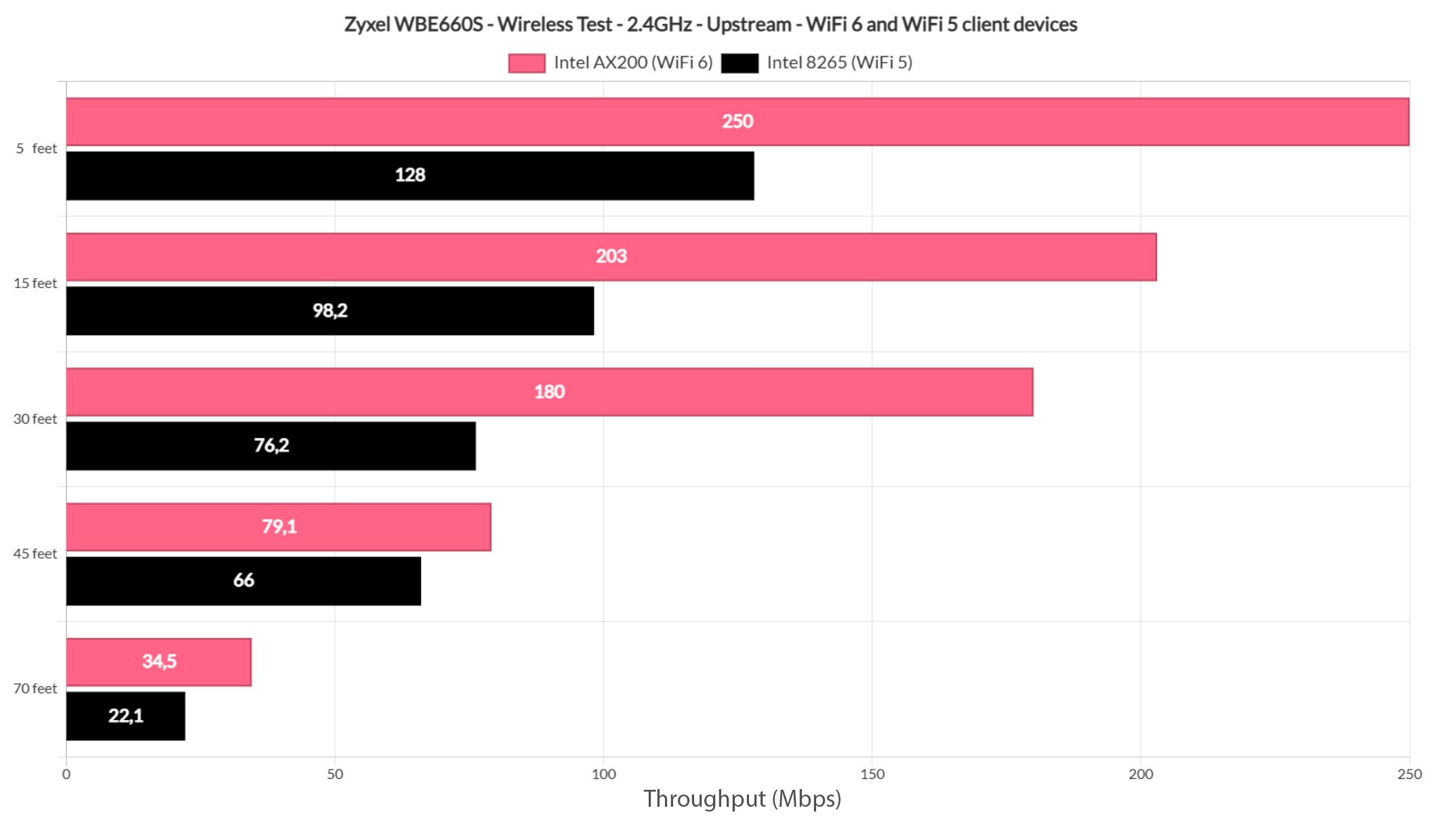
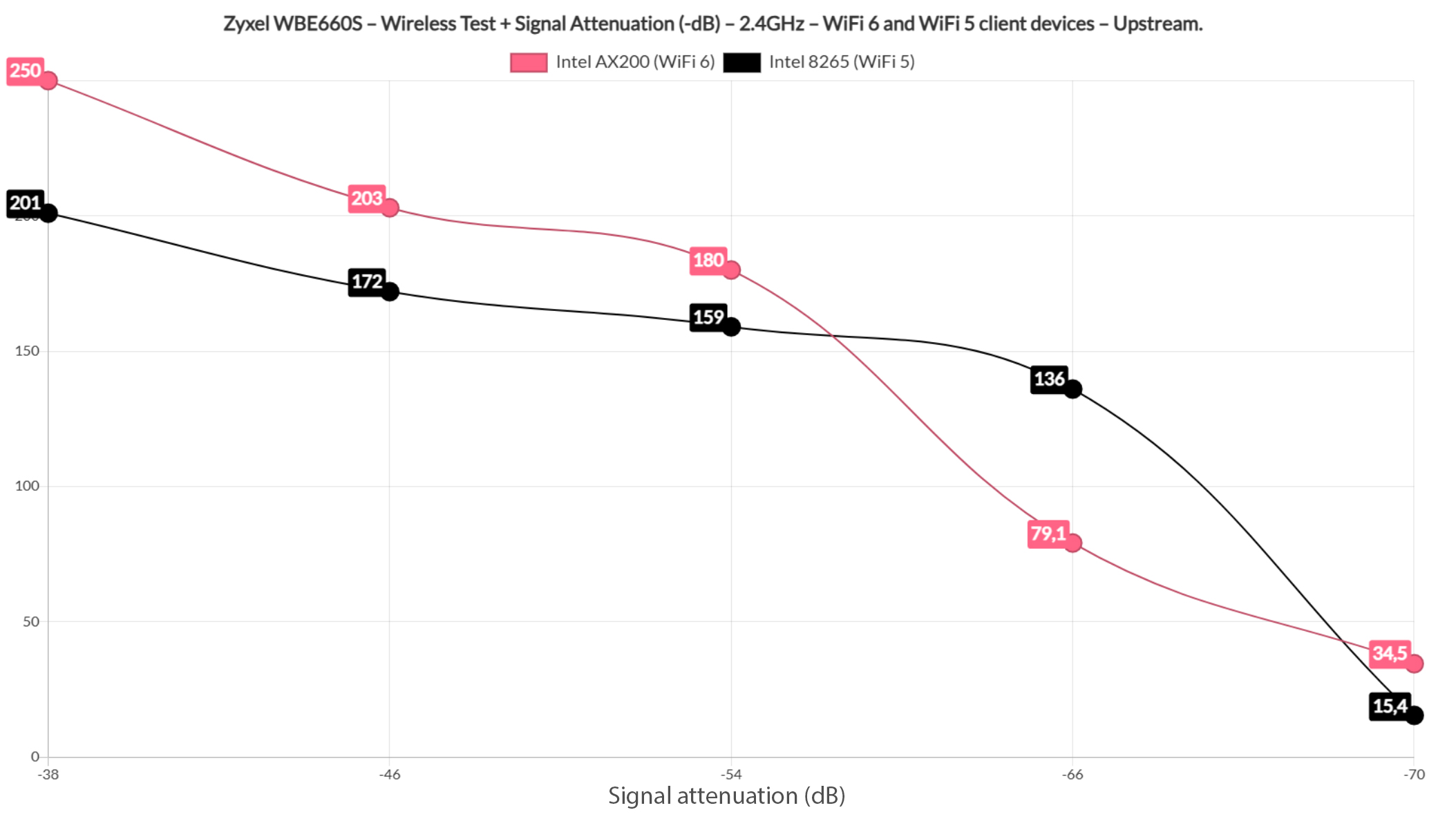
It’s a good efficiency, clearly adjusted to be appropriate largely for IoT gadgets and a few outdated pill. I additionally included the necessary sign attenuation graphic to make it straightforward so that you can reproduce these leads to your personal residence.
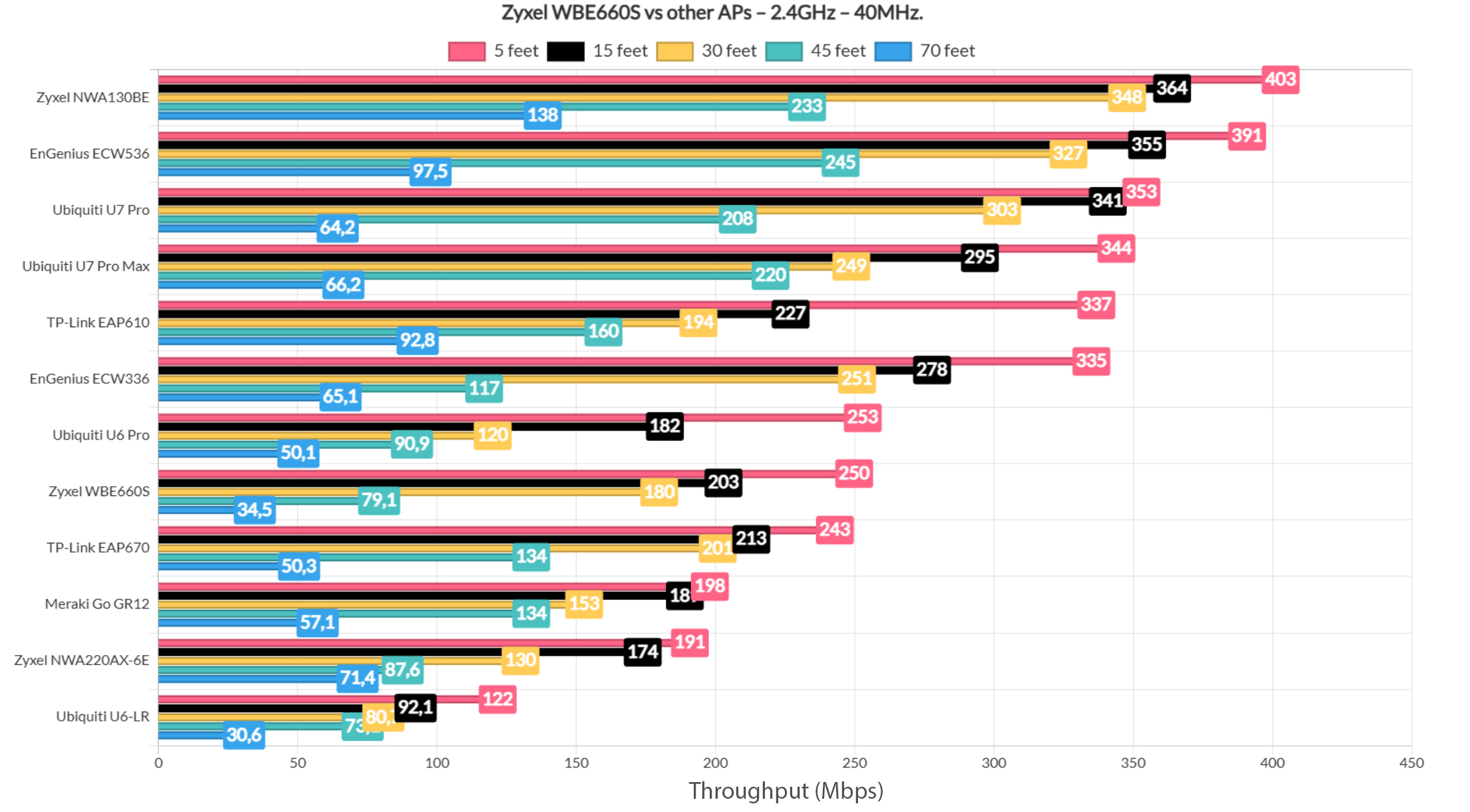
And a comparability desk with different entry factors. Not actually on the high right here, however like I stated, it’s a good efficiency, nothing spectacular or something of the kinds.
The Multi-Client Tests
OK, so now let’s transfer over to the multi-client exams. Things get a bit extra difficult, however bear with me as a result of the idea is definitely pretty easy. I’ve one server pc related to the change which powers up the entry level after which 5 consumer gadgets related by way of WiFi. You can see every consumer’s specs on this desk. I then used a device referred to as net-hydra developed by Mr Jim Salter and which is on the market on Github.com to simulate several types of visitors.
Then, we are able to see the latency which we wish to be as near zero as attainable. The first check simulates 1080p streaming on 5 consumer gadgets.
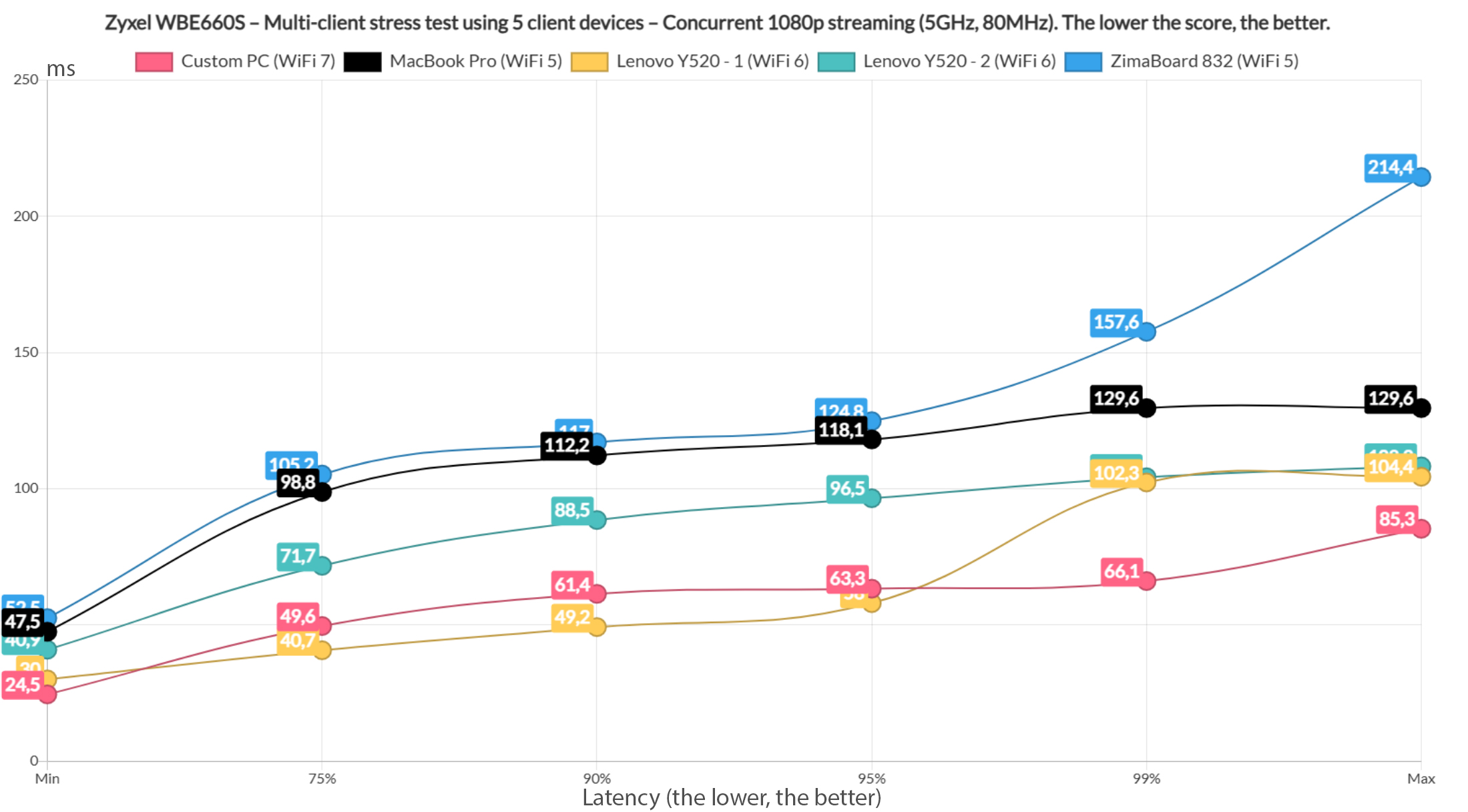
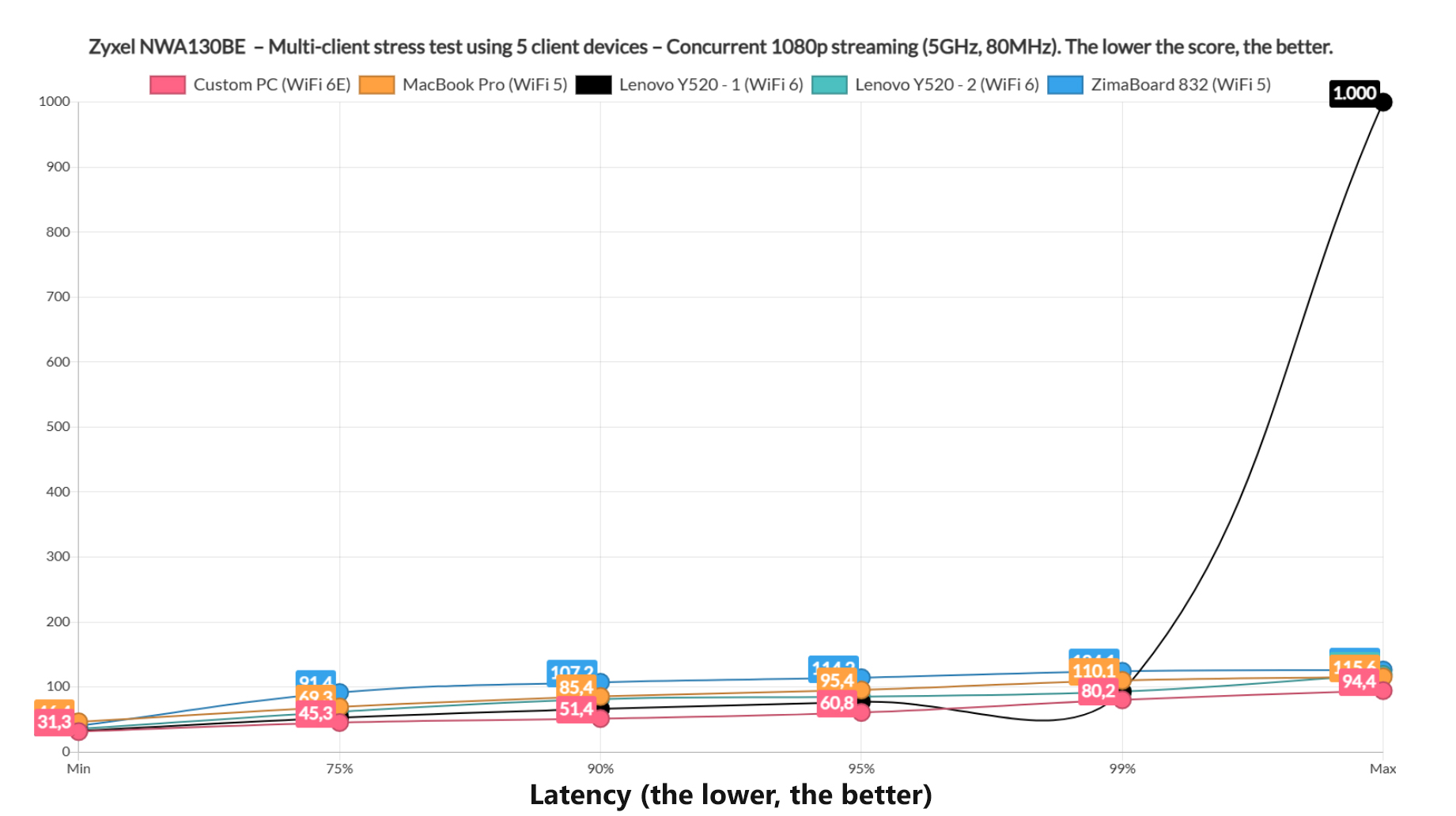
And we see the WiFi 7 and one WiFi 6 consumer doing decently properly, whereas the second WiFi 6 laptop computer rises close to 100ms rapidly. The WiFi 5 shoppers instantly cross 100ms instantly which isn’t good. So far, it’s a considerably related efficiency to the Zyxel NWA130BE.
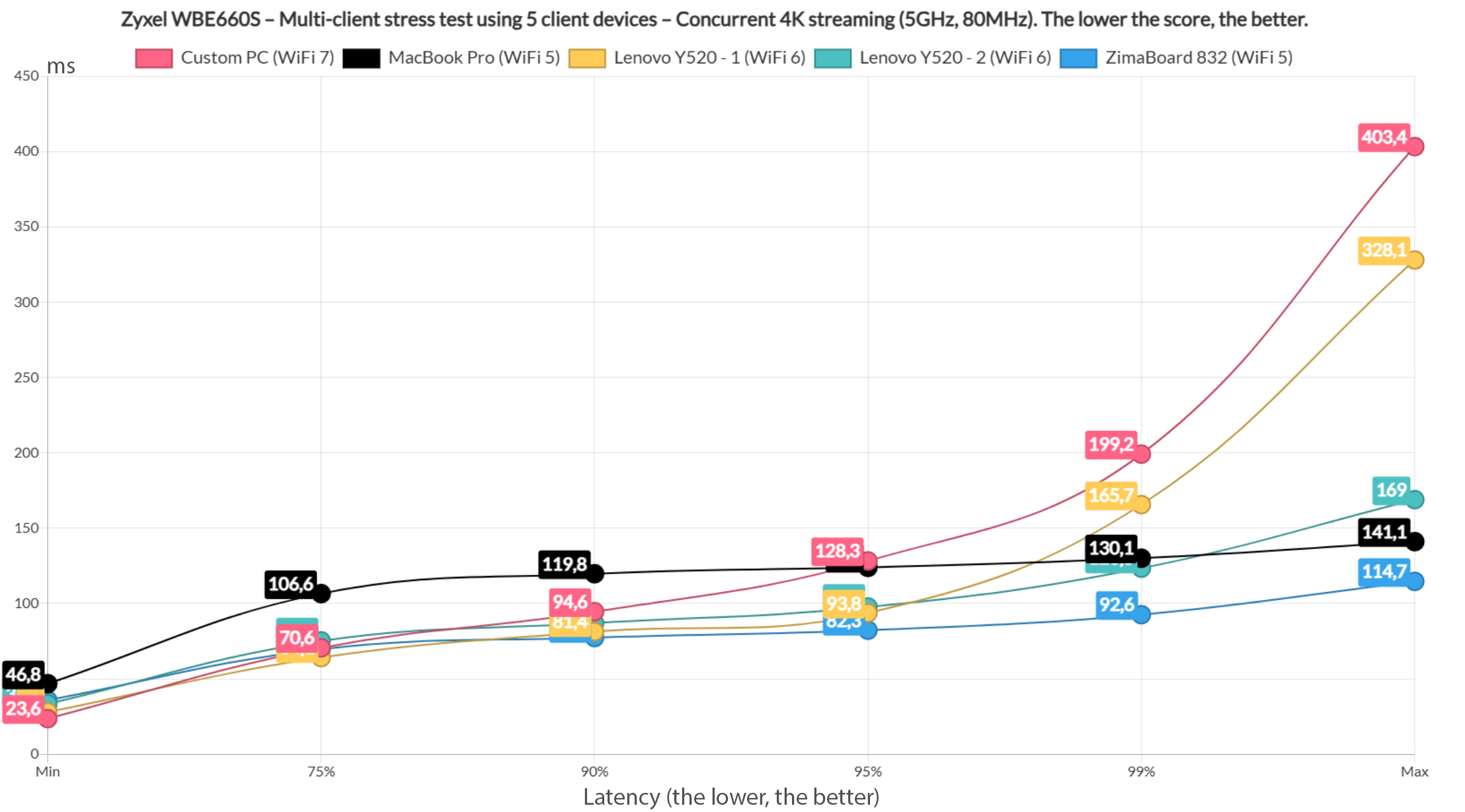
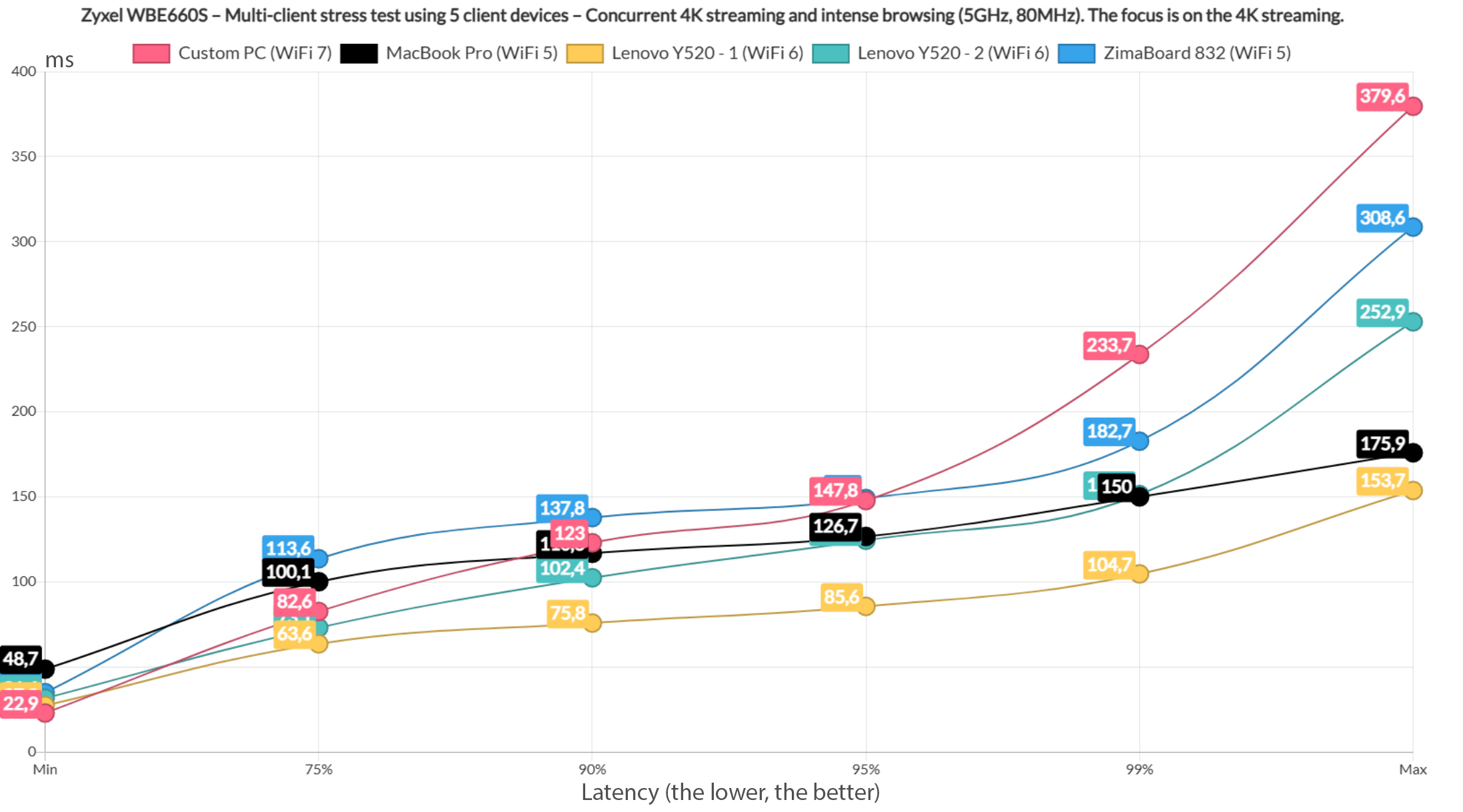
Running 4K streaming (35Mbps) on the 5 shoppers, we see that the WiFi 5 shoppers choose to remain above 100ms, whereas the opposite three did a bit higher, however nonetheless not an outstanding efficiency.
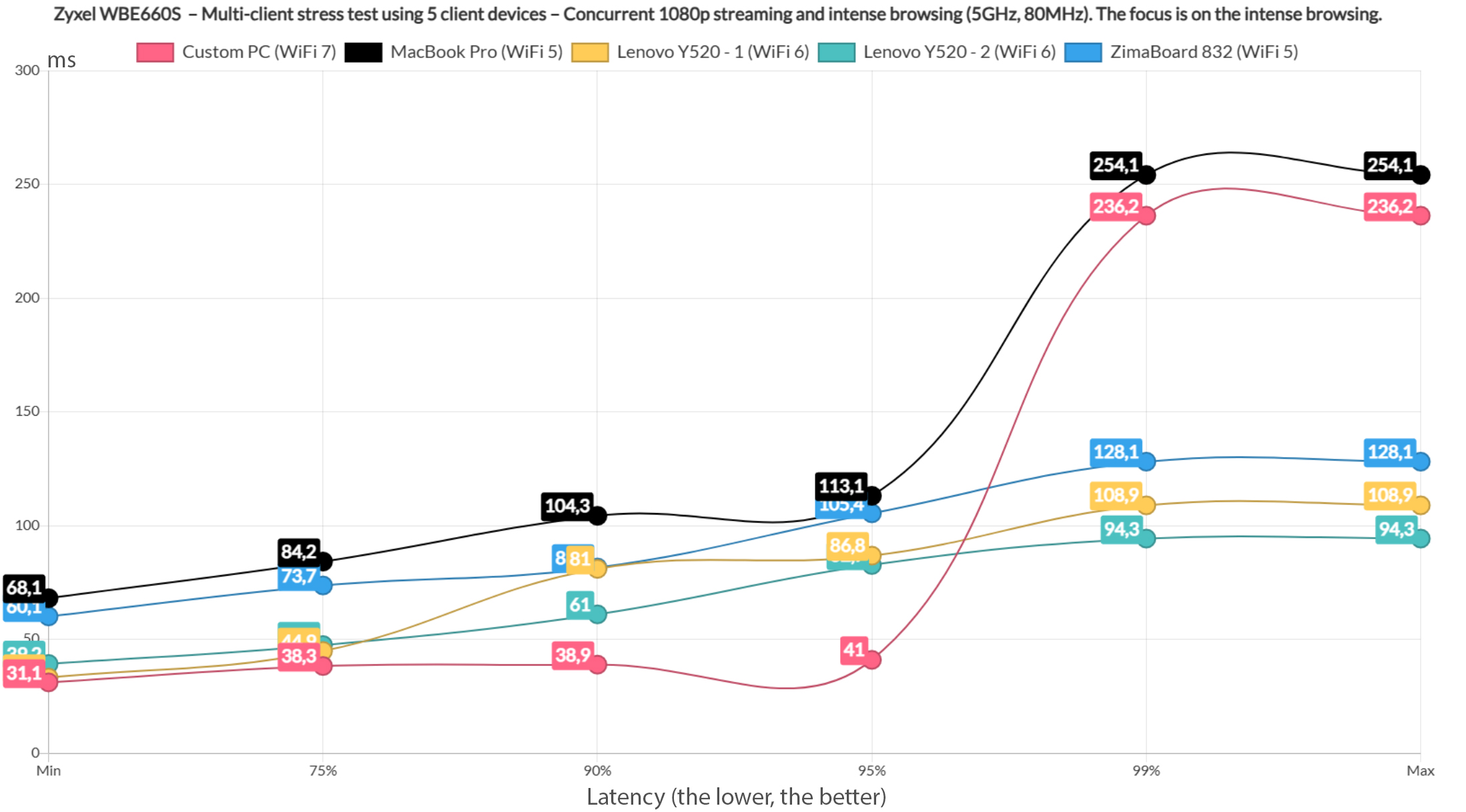
If it is advisable to run an analogous sort of visitors, be certain so as to add at the least one consumer utilizing a wired connection. Now let’s add intense searching into the combination the place a web page is opened each few seconds which is able to run alongside 1080p streaming.
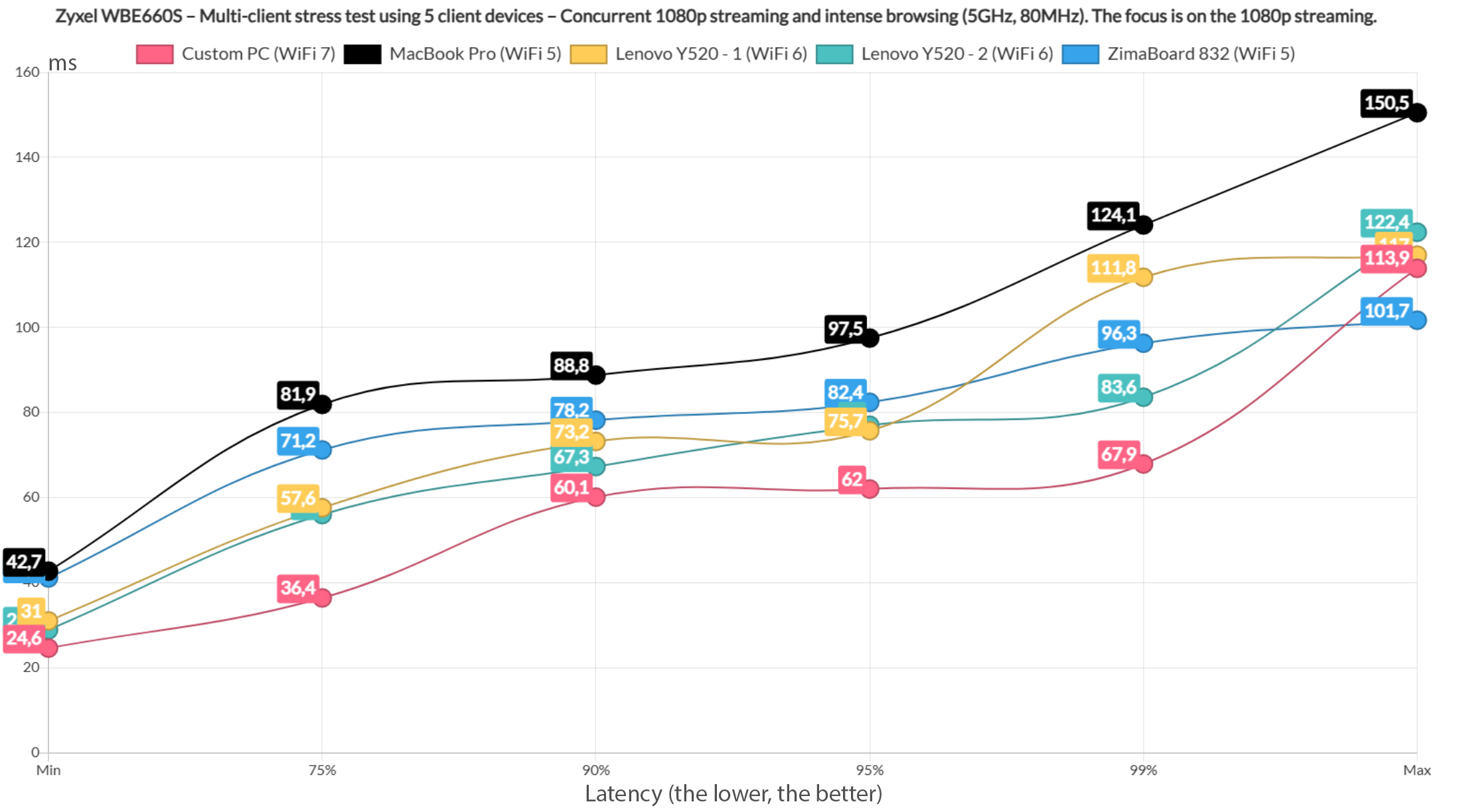
And, as we are able to see from the graphic, the WiFi 7 consumer once more does very well, the 2 WiFi 6 consumer stay respectable, whereas the 2 WiFi 5 shoppers have a tendency to indicate increased latency.
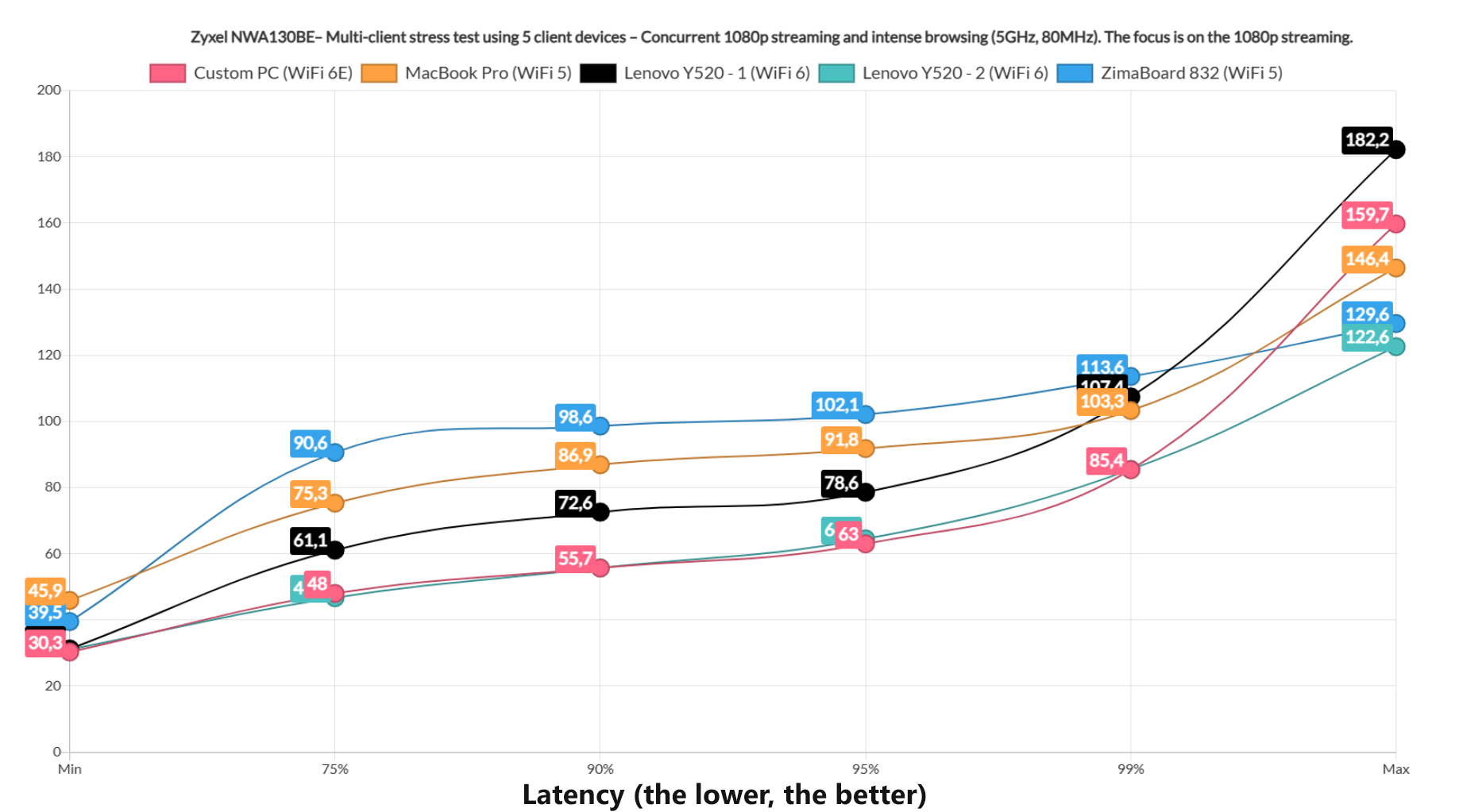
When in comparison with the NWE130BE, the WBE660S as soon as once more does a bit higher. The intense searching graphic pushes the WBE660S as a transparent winner over different WiFi 7 APs that I examined thus far.
But we have to run the identical check however with 4K streaming as an alternative of 1080p. And, properly, the streaming graphic exhibits one WiFi 6 because the winner, whereas the remaining rapidly rise above 100ms which we don’t need when streaming films.
It’s attention-grabbing to see that the extraordinary searching graphic exhibits that aside from two consumer gadgets which rose above 1s for about 10% of the time, the remaining did very well.
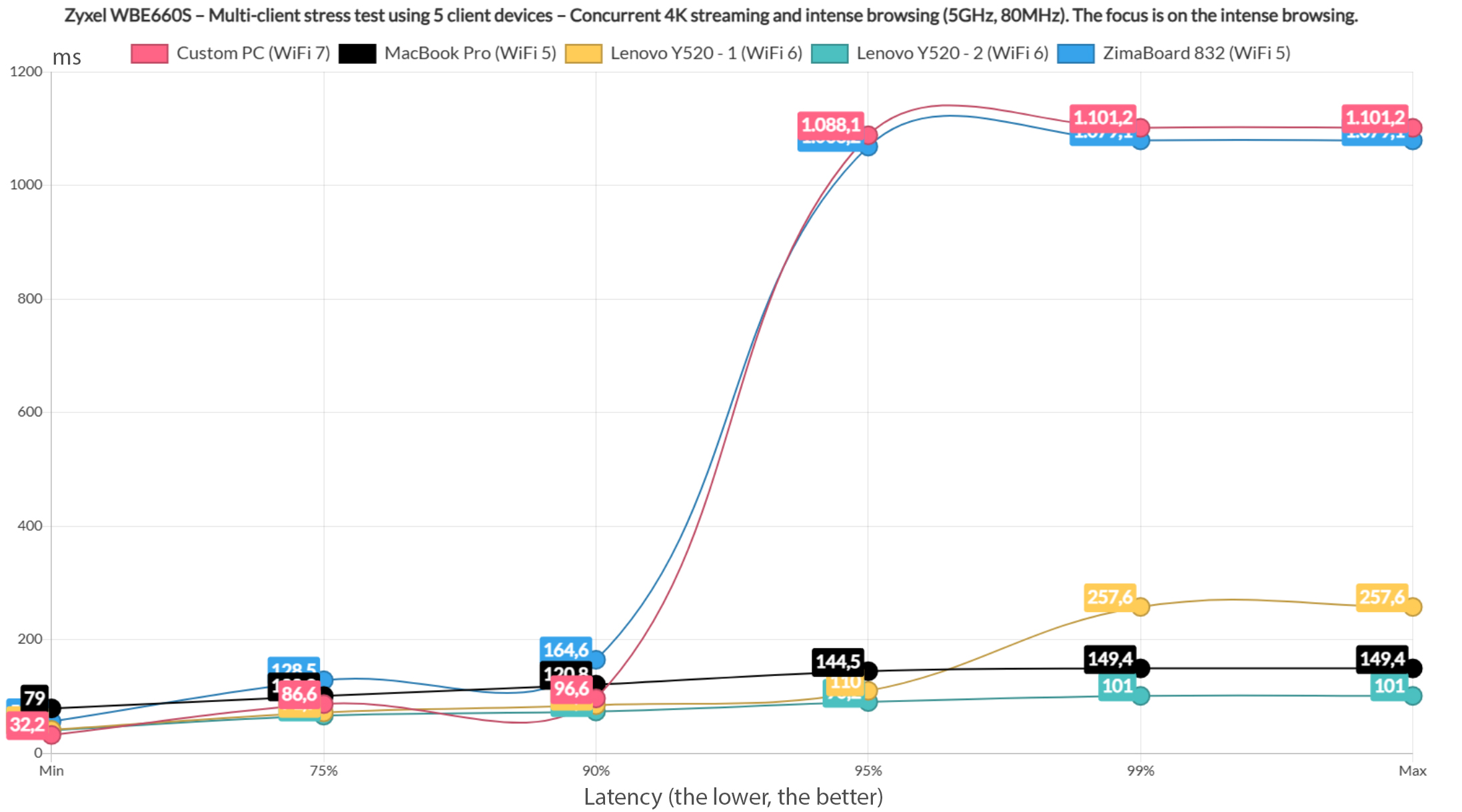
Then once more, something beneath 1.5s is suitable. Moving on, I included the downloading visitors which includes the obtain of a 10MB file repeatedly and no cap concerned, so the consumer machine can request as a lot because it desires from the accessible bandwidth.
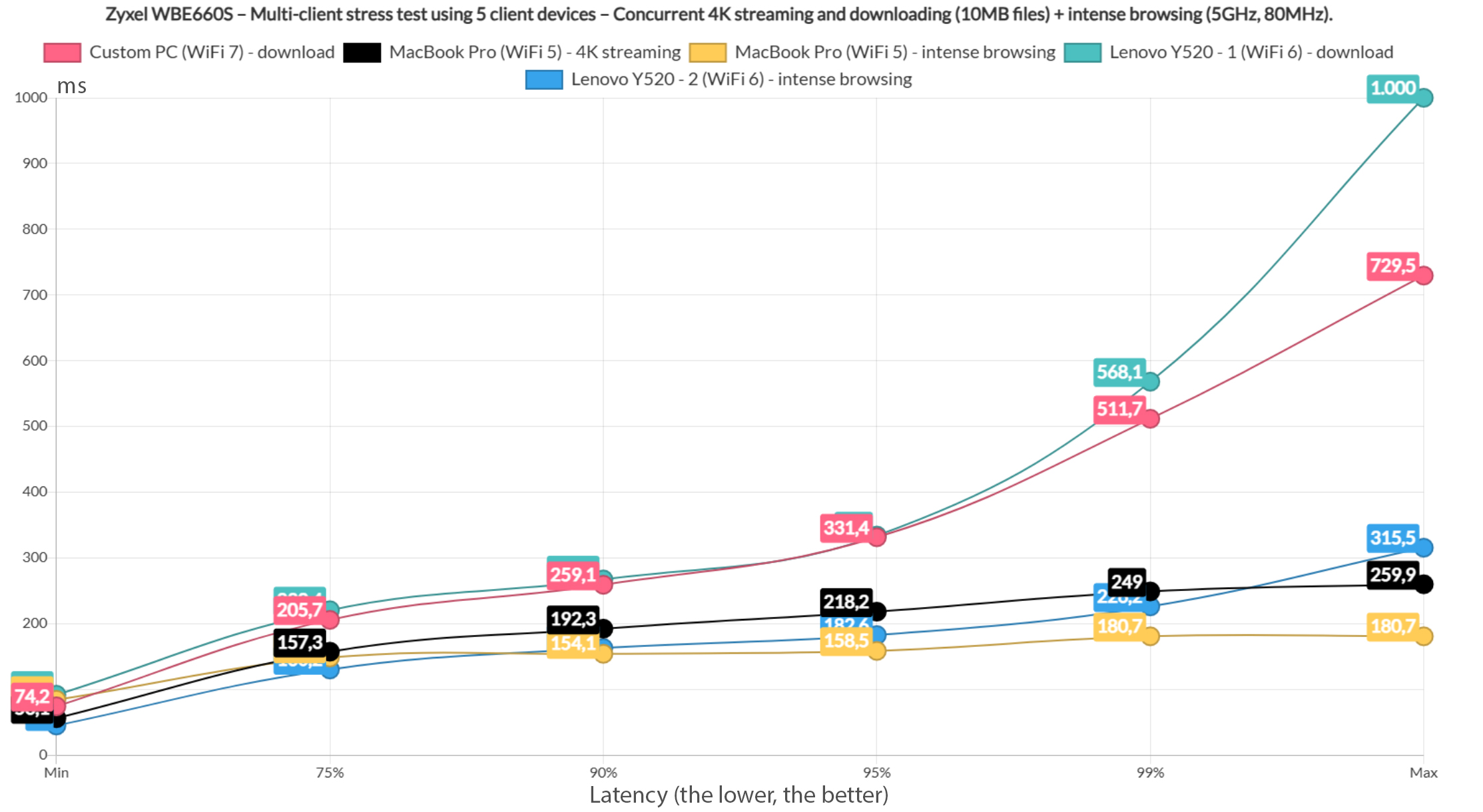
And I began with two shoppers which, in whole bought as much as 786.6Mbps. Not dangerous contemplating that this we use the 80MHz channel bandwidth and the 5GHz radio. And the latency is definitely higher than anticipated. I do know that 200ms and above is dangerous, however should you try the NWE130BE and the U7 Pro in addition to the Pro Max, these are phenomenal values. The 4K streaming struggled as properly, however once more, a lot better than with different WiFi 7 entry factors.
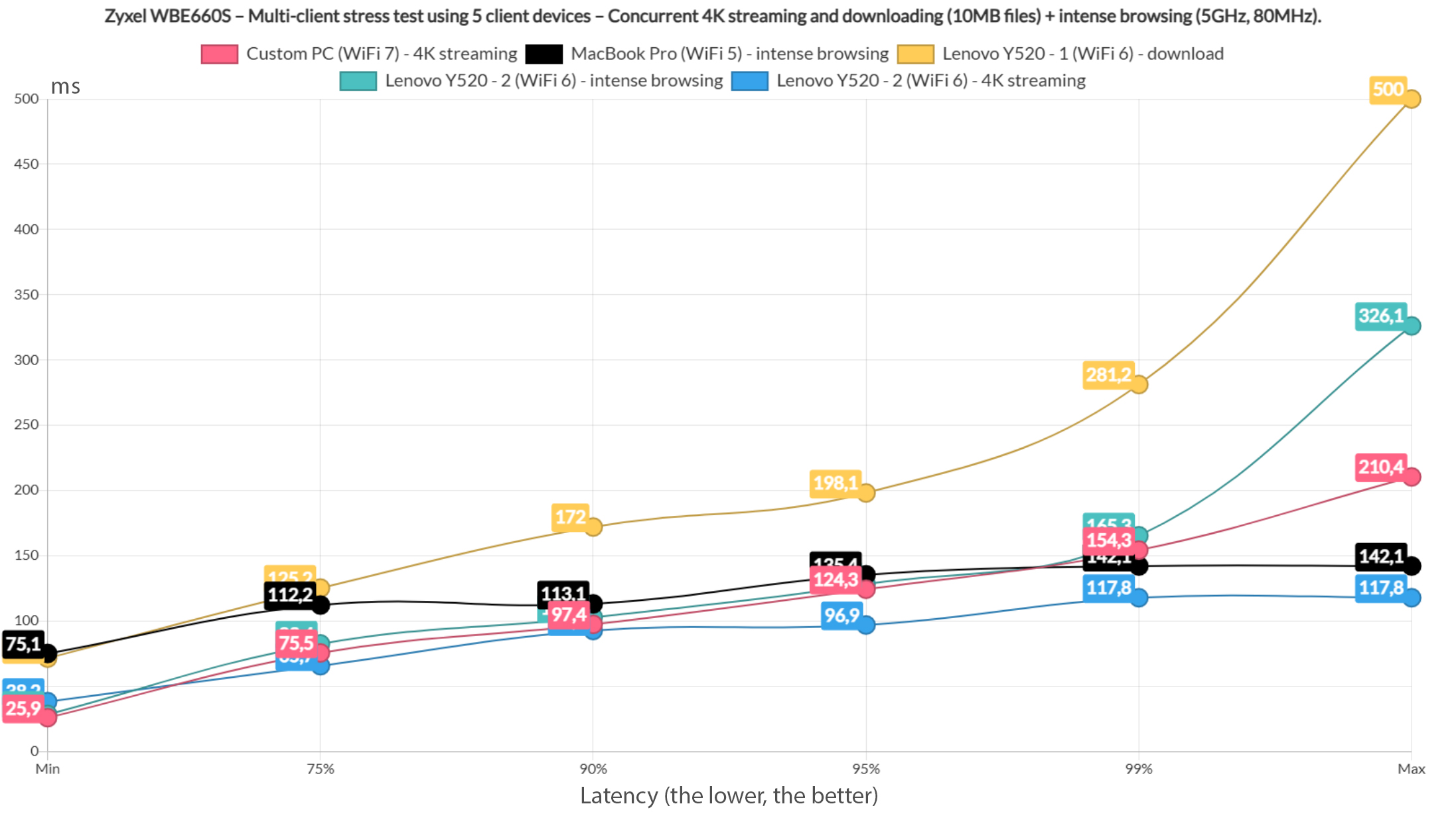
Switching to a single downloading consumer, issues bought even higher. Again, above 100ms is just not good for something apart from Internet searching, however the values are nonetheless miles higher than with different WiFi 7 APs. It’s not even comparable.
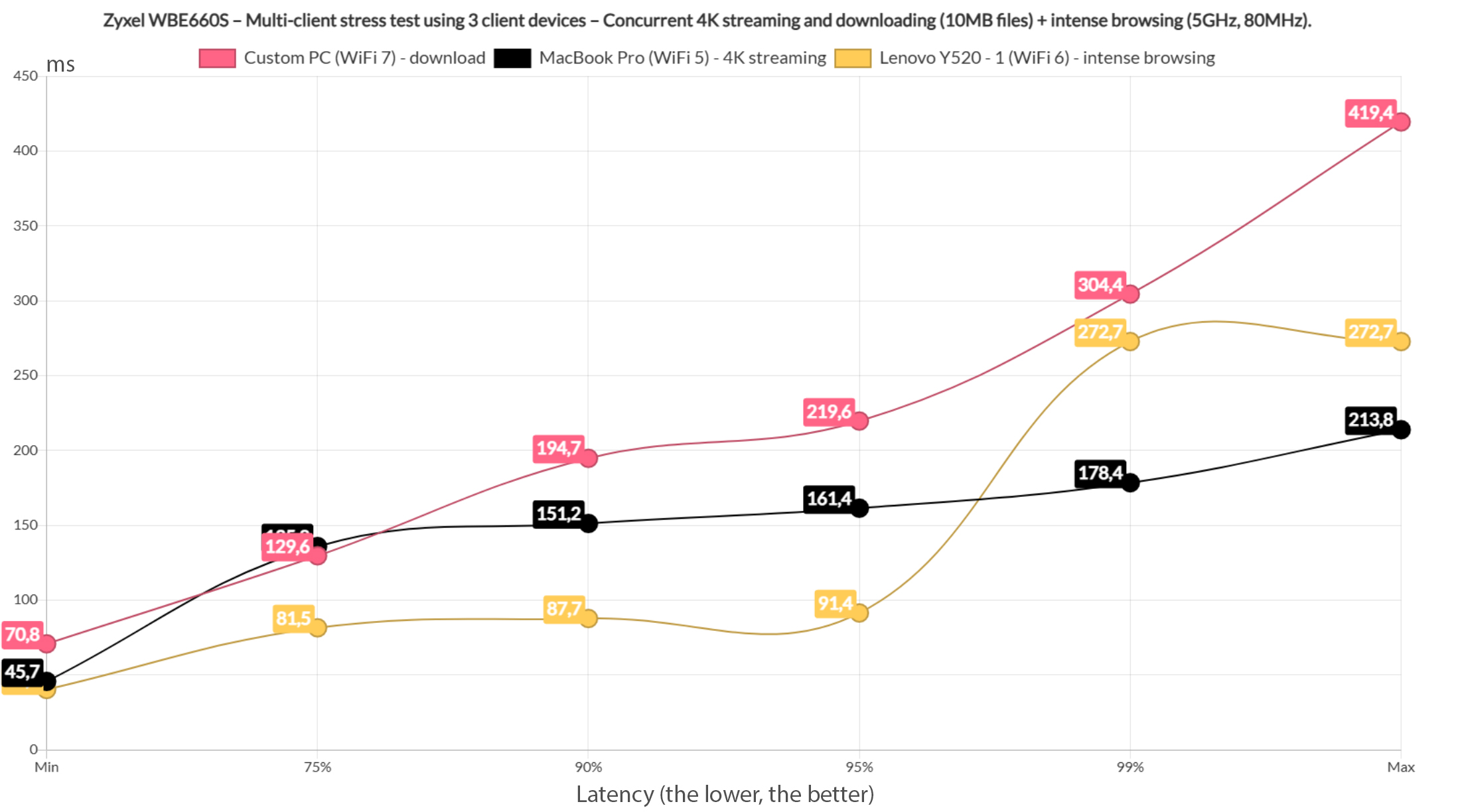
Let’s make issues lighter for the Zyxel WEB660S through the use of solely three consumer gadgets, one for downloading, one for 4K streaming and the final for intense searching. The downloading consumer’s latency remained just about the identical as earlier than, so we have to make another adjustments.
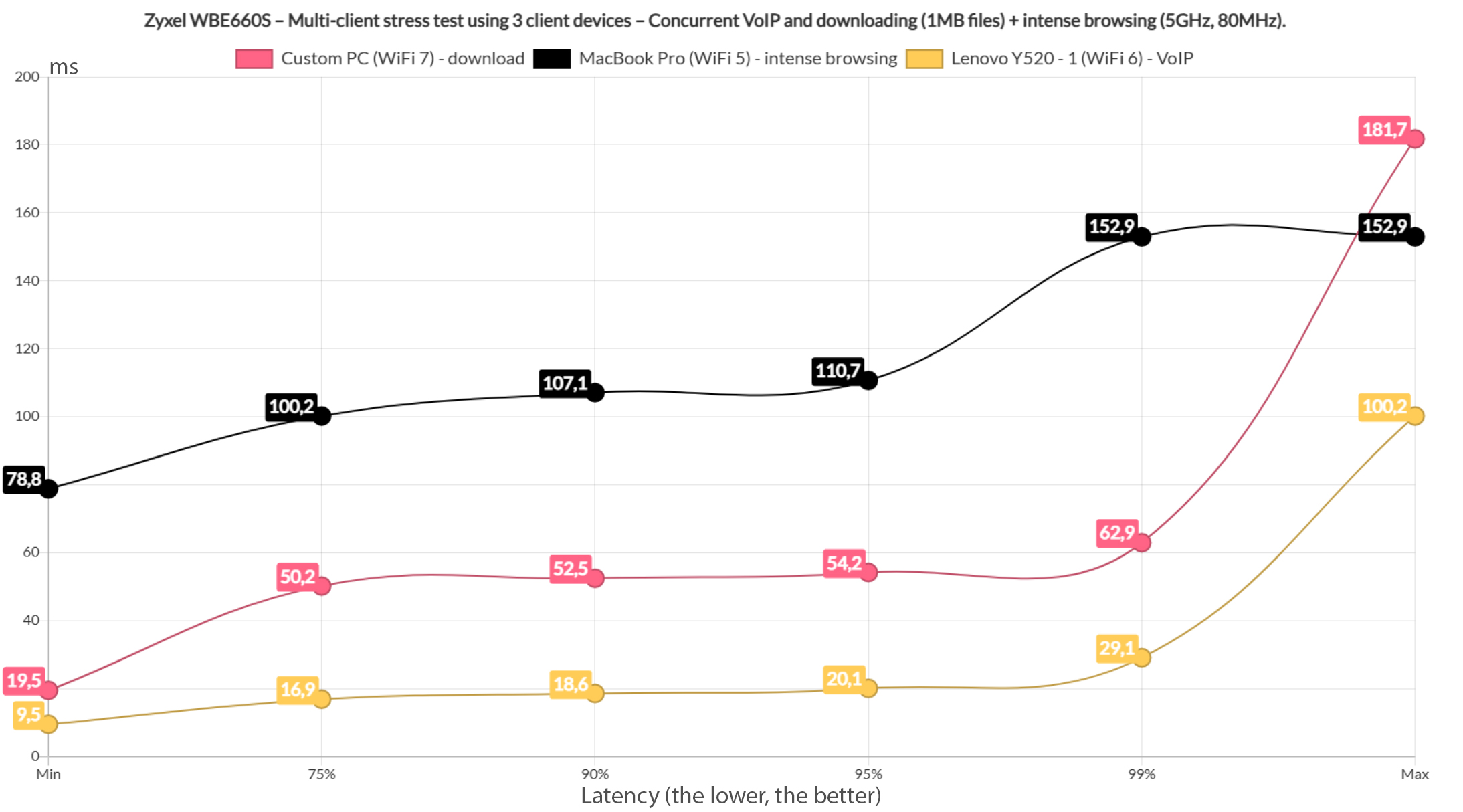
I made a decision to obtain a 1MB file repeatedly this time, hold the extraordinary searching and the third consumer would attempt to run VoIP visitors. And the downloading consumer did decently properly this time, the extraordinary searching was good as at all times, whereas the VoIP latency moved between 17 and 30ms which I suppose is okay.
Lastly, I needed to run the 10MB downloading visitors on all 5 consumer gadgets only for enjoyable and the outcomes are attention-grabbing. One consumer, the far-away WiFi 5 machine went out of charts, however the different shoppers have been truly dealt with higher than anticipated.
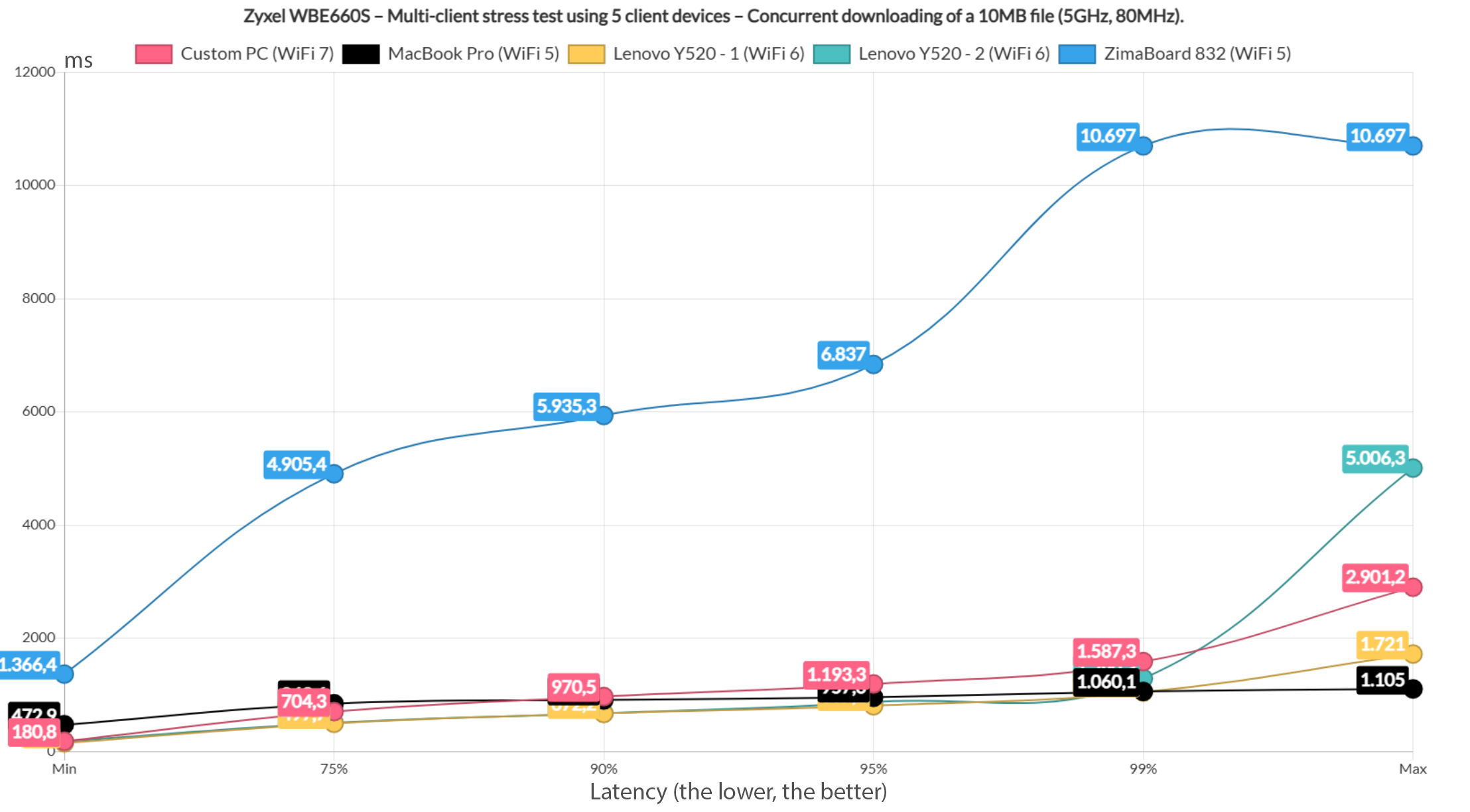
Much higher than what I noticed with different WiFi 7 entry factors.
The MLO Performance
It’s been some time since I examined the MLO efficiency of the NWA130BE and the U7 Pro, and fortunately, issues bought a lot better because of driver and firmware updates. So, I made a decision to run some fast exams utilizing just about all accessible configurations and the outcomes have been spectacular.
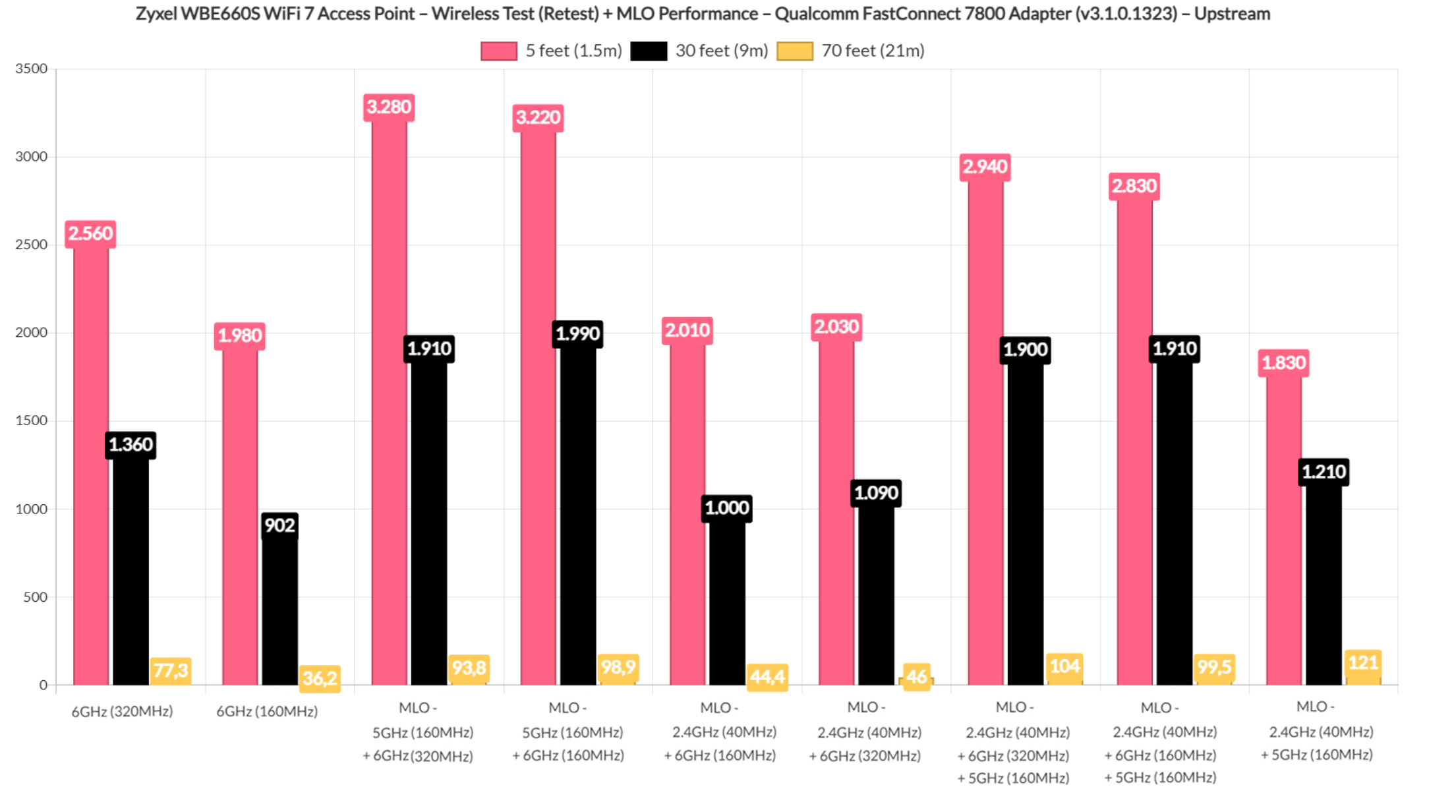
I’ve added the throughput registered utilizing solely the 6GHz radio and on each the 320MHz and the 160MHz channel bandwidth. And then, I aggregated the 6GHz radio with the 5GHz one. I noticed the perfect values utilizing the 320MHz, the place I noticed practically 3.3Gbps upstream, however even the 160MHz channel width did higher than anticipated.
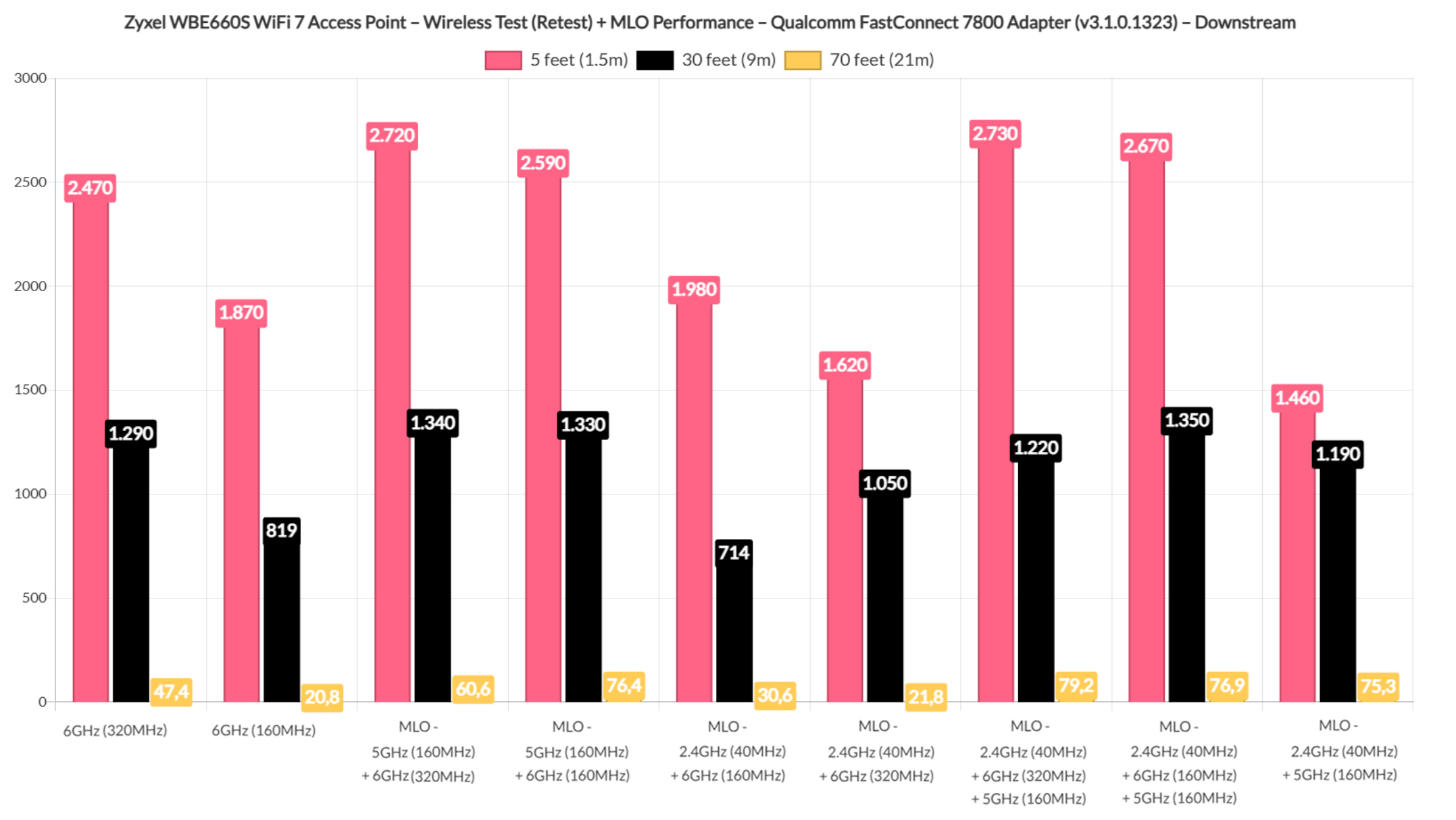
Downstream, we’re not coping with some big throughput distinction, the efficiency staying very near what we noticed upstream. After aggregating the 6GHz radio band with the two.4GHz one which was set to make use of the 40MHz channel bandwidth, we see that it will possibly get near 2Gbps each upstream and downstream. Then, I aggregated all three accessible radio bands and I bought the perfect throughput thus far, 2.73Gbps, whereas downstream, we see that it dipped beneath 3Gbps.
Lastly, I aggregated the two.4GHz and the 5GHz radio bands and this time, we have to deal with the 70 foot efficiency which is a lot better than with all different MLO configurations. That’s solely upstream as a result of downstream, it’s nearer to the typical efficiency. I additionally ran FLENT and these are the latency values that I bought.
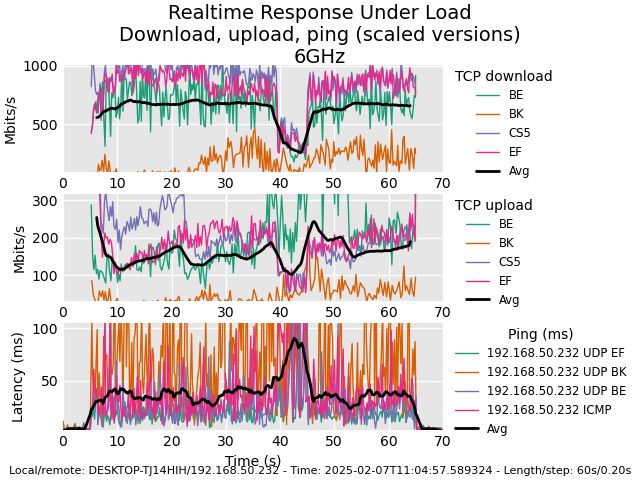
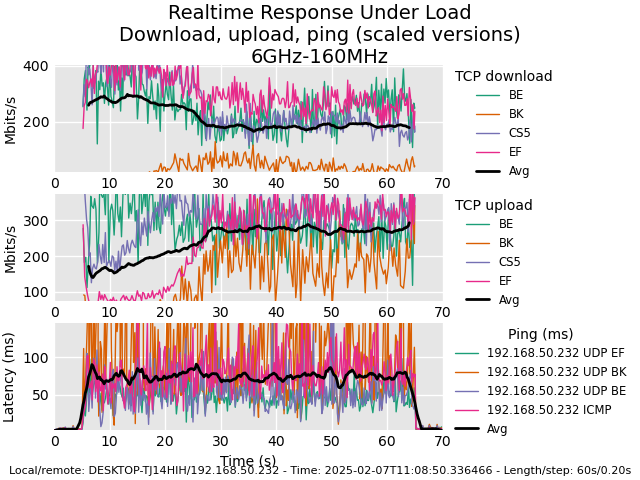
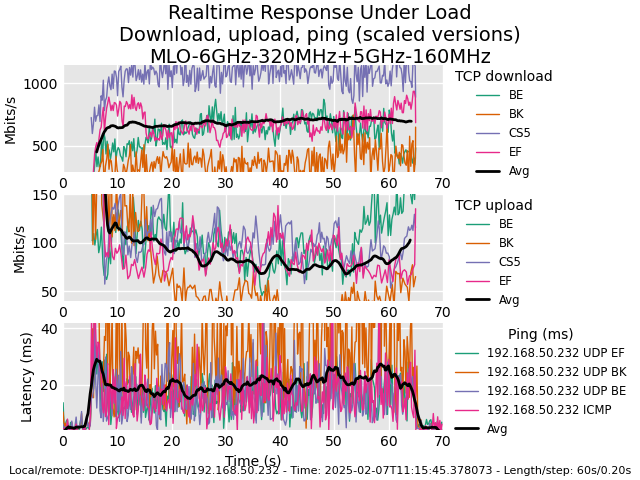
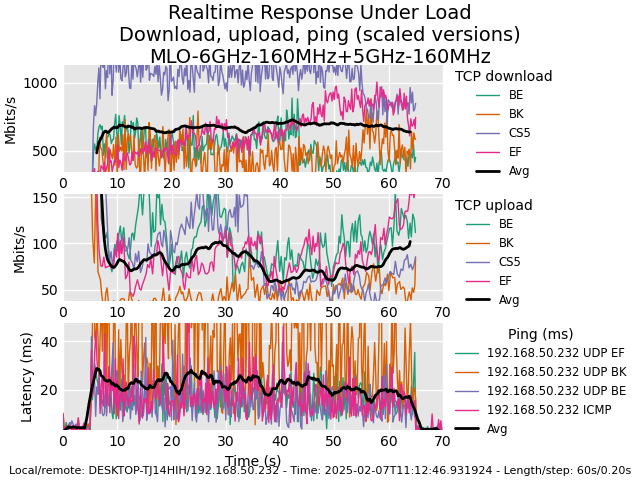
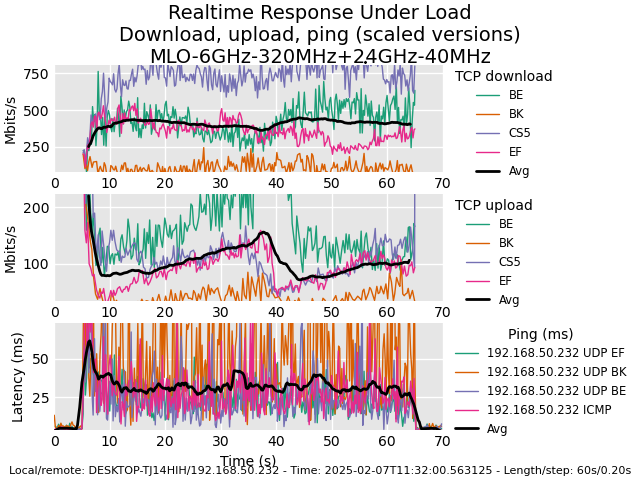
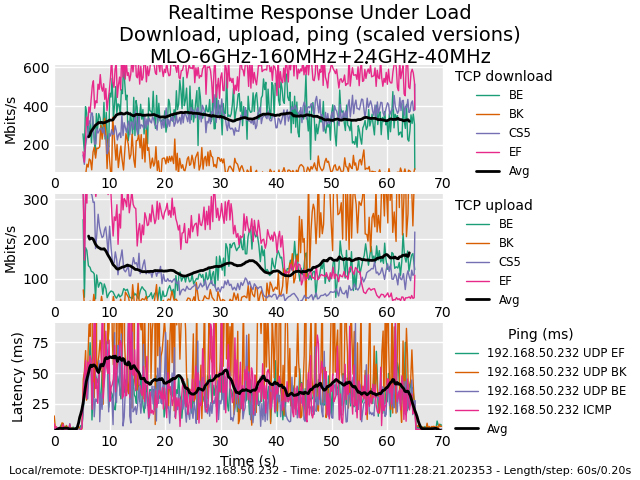
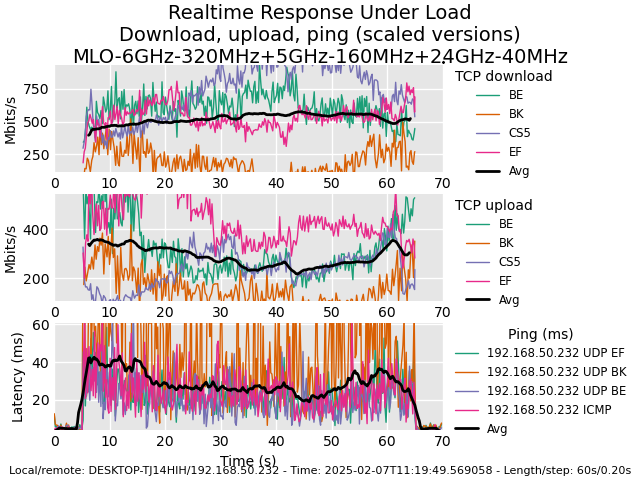
5GHz(160MHz) & 2.4GHz(40MHz).
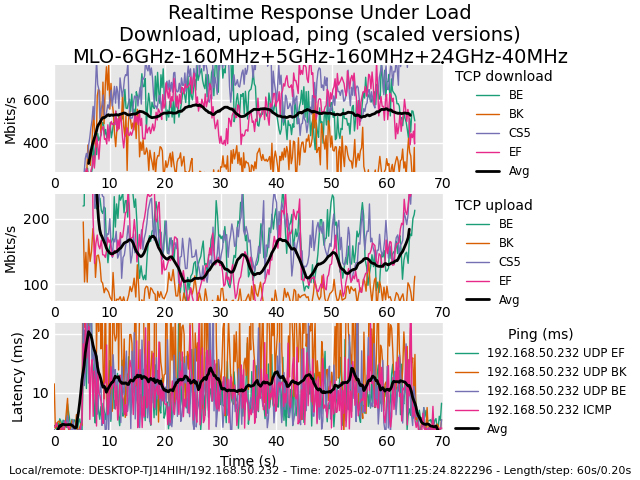
5GHz(160MHz) & 2.4GHz(40MHz).
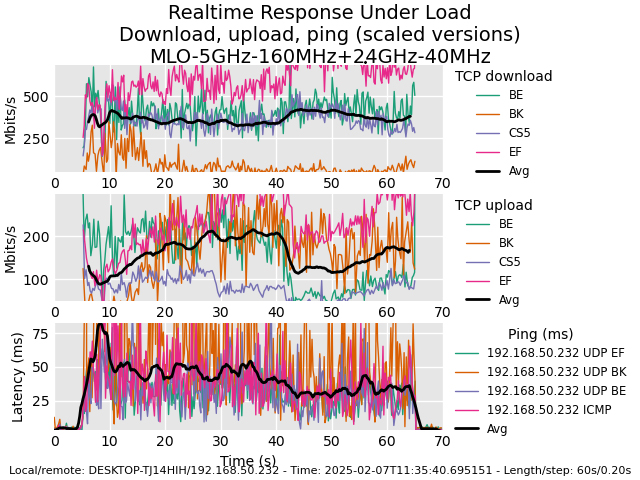
The Standalone Platform
Just just like the NWA130BE, there’s a very complete standalone platform as properly. And it’s additionally just about equivalent as we are able to see the 4 major sections on the left facet. The Dashboard exhibits detailed standing data consisting of varied widgets and sure, you possibly can select which is able to keep and which is able to go. Then, there’s the Monitor the place, we get extra in-depth with the standing data.
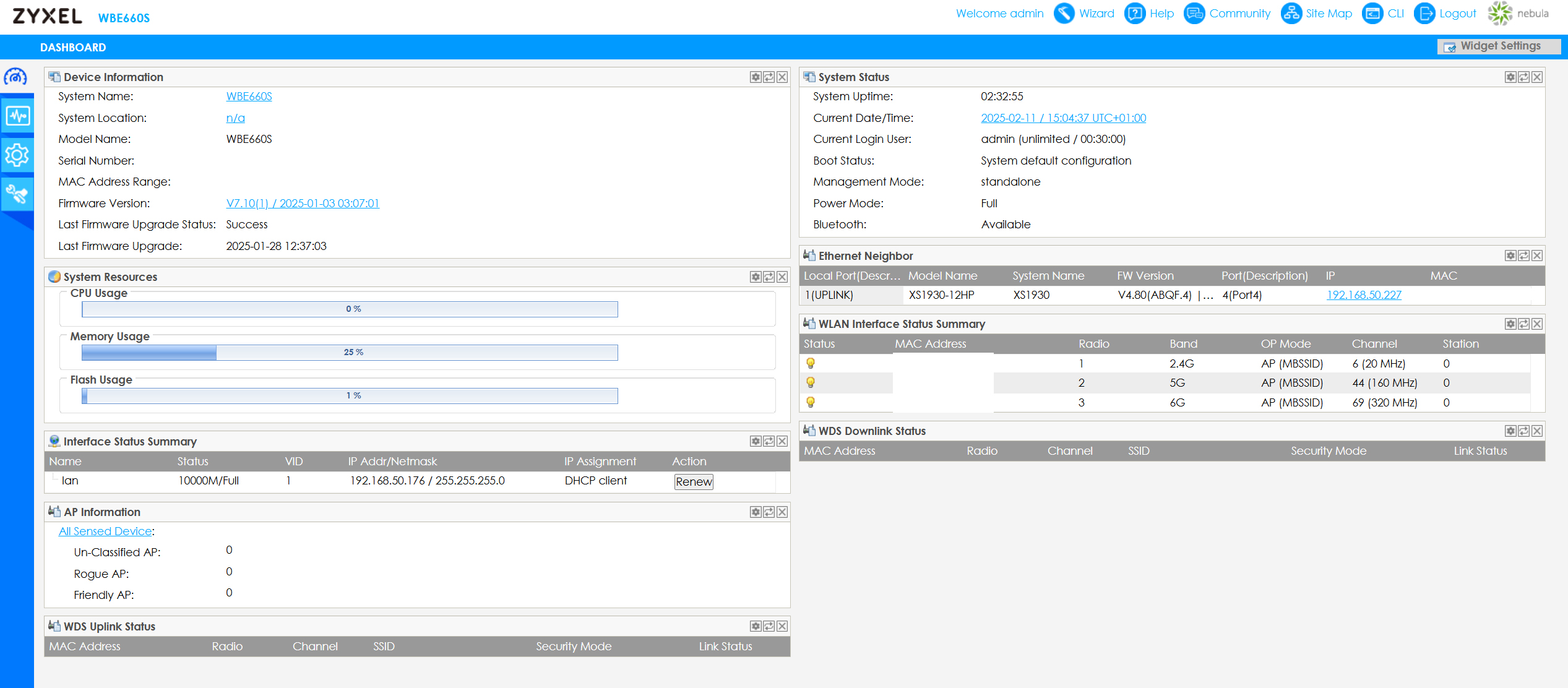
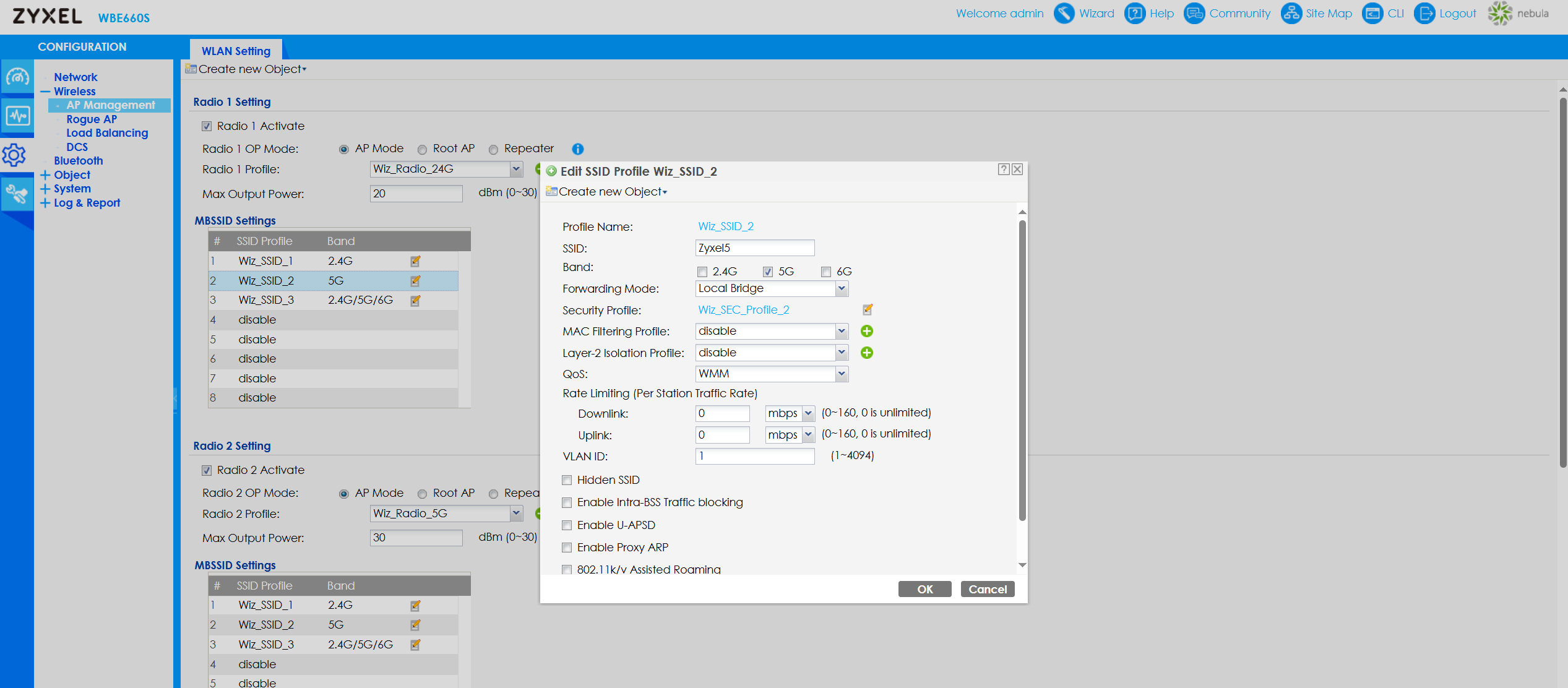
We can see some Radio data, if there may be any Station or WDS Uplink and Downlink data accessible, examine whether or not the Rogue AP detection discovered one thing and simply have have a look at the Log data. Then, there’s the Configuration part which works deep into Network changes together with VLAN and Storm Control. While beneath Wireless, there’s the AP Management the place we are able to change how every Radio behaves and it does embrace establishing SSIDs as properly.
We additionally get Load Balancing and DCS, and a extra old-school method of Object configuration. Under Maintenance, we are able to change the system configuration information, replace the firmware, use the Diagnostic Info Collector and the Remote Capture. Sure, there may be extra to it, however let’s additionally take a look on the Nebula Controller.
The Nebula Controller
Just like with the NWA130BE, I’m going to make use of the Basic License and, the expertise is just about the identical with the Zyxel WBE660S. There’s the Dashboard the place you get to see numerous standing data in regards to the AP and different gadgets on the identical web site. Then, we get to see the entry level beneath Devices which incorporates another personalised data, such because the Map, in addition to some Live Tools. But a very powerful are what we discover beneath Configure as a result of we get to arrange the SSID and the Radios.
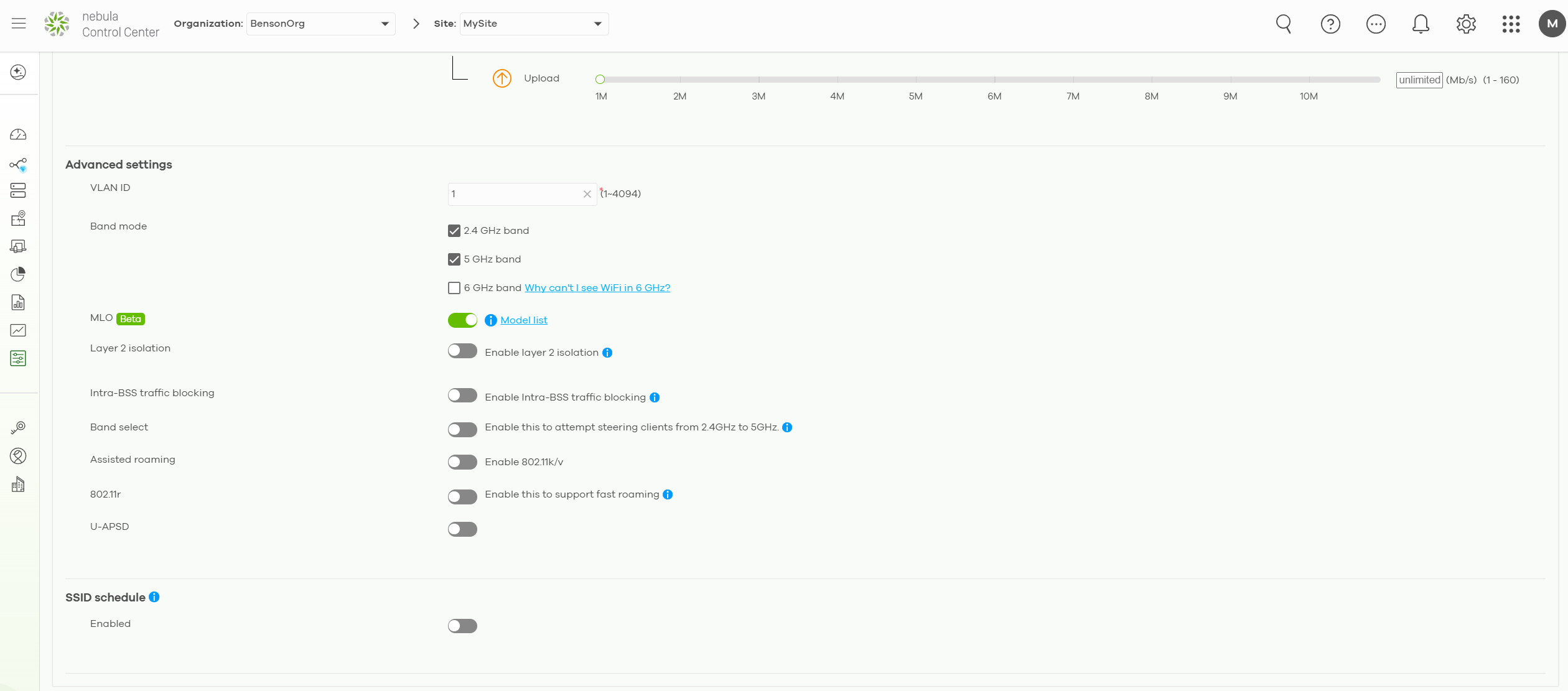
The SSID settings are differentiated in regular settings and a few superior ones. These embrace the choice so as to add and arrange SSIDs and, sure, right here is the place you get to allow MLO as properly. It’s attention-grabbing to see that beneath the Radio Settings, you possibly can select the channel and channel bandwidth, however the 5GHz radio is restricted to 80MHz. To go to 160MHz, it’s required that you simply scroll to the underside of the web page, establish the entry level, select the radio after which, you get to vary the radio settings for it individually, overwriting the worldwide ones.
Then once more, earlier than anything, you do want to go to the License and stock part the place you possibly can add new gadgets, set the Site the place they’ll function and assign a license.
The Conclusion
The Zyxel WBE660S prices fairly a bit greater than the NWA130BE, however, contemplating the similarities by way of options and used applied sciences, is it truly price the additional price? The WBE660S is unquestionably a better-performing machine and it’s the perfect WiFi 7 entry level that I examined thus far, so it’s price paying further. Is it price double or extra the value of the NWA130BE, that, I’m not so positive about. You positively don’t get double the throughput or that a lot much less latency.

Mark is a graduate in Computer Science, having gathered useful expertise through the years working in IT as a programmer. Mark can be the principle tech author for MBReviews.com, overlaying not solely his ardour, the networking gadgets, but in addition different cool digital devices that you could be discover helpful on your each day life.