

How to Check Your PC Specs in Windows Leave a comment
A fast information to make it easier to discover out what specs your PC has.
If you’re planning on upgrading your laptop, fixing an issue together with your system, or simply need to know what you’re working with, you might want to test your PC’s specs. Fortunately, you don’t have to open up your system or obtain something sophisticated to discover out what components you’ve got.
Windows provides you just a few alternative ways to shortly test your system’s predominant elements like its processor, graphics card, reminiscence, and storage. In this information, we’ll present you the best methods to discover your specs, together with just a few instruments you should use if you need much more detailed data.
Whether you’re making an attempt to determine if an improve is sensible otherwise you simply need to know precisely what’s inside your machine, we’ve obtained you lined.
The simplest way to test your laptop’s {hardware} is by utilizing considered one of these built-in Windows instruments:
- System Information: Type ‘system’ into the Windows search bar and hit Enter. This exhibits your CPU, RAM, Windows model, GPU (underneath Components > Display), and motherboard information (on newer techniques).
- About Your PC: Type ‘about’ into the Windows search bar and hit Enter. This shows your CPU, reminiscence, and Windows model.
- Task Manager: Type ‘task’ into the Windows search bar and hit Enter. Then change to the Performance tab to view your CPU, reminiscence (together with pace), and GPU data.
Step-By-Step Video Tutorial

Quick Comparison: Where to Find Your PC Specs in Windows
| Tool | CPU | GPU | RAM | Storage | Motherboard |
|---|---|---|---|---|---|
| System Information | ✅ | ✅ | ✅ | ❌ | ✅ |
| About Your PC | ✅ | ❌ | ✅ | ❌ | ❌ |
| Task Manager (Performance Tab) | ✅ | ✅ | ✅ | ❌ | ❌ |
| Device Manager | ❌ | ✅ | ❌ | ✅ | ❌ |
Additionally, you’ll be able to test every particular person part in your system utilizing the steps supplied under.
How to Check Your CPU
If you’re questioning what sort of processor you’ve got, you’ll be able to simply discover out that data on a Windows 11 (or older) laptop in two clicks.
Check Your CPU in System > About
To discover out what CPU you’ve got, merely do the next:
- Type ‘about’ in the Windows search bar and hit enter.
- Next to ‘Processor’ it’s going to listing what sort of CPU you’ve got in your laptop.

Easy, proper?
How to Check Your Graphics Card
To discover out what sort of graphics card you’ve got, there are just a few totally different strategies you should use. If you want to discover out the particular mannequin of graphics card you’ve got, use GPU-Z and the third technique under.
Check Your GPU in Task Manager
To shortly discover out what GPU you’ve got, do the next:
- Type ‘task’ in the Windows search bar and hit enter.
- In Task Manager click on on Performance on the left-hand menu (second possibility down).
- Your GPU will probably be listed right here.

Check Your GPU in Device Manager
You may discover out what GPU you’ve got by Device Manager:
- Type ‘device’ in the Windows search bar and hit enter.
- In ‘Device Manager’ click on on the arrow subsequent to ‘Display Adapters’
- Your GPU will probably be listed there.

If you’re checking by way of Device Manager, it needs to be famous that it’d present two choices underneath the ‘Display Adapters’ tab. If it exhibits two choices, meaning it’s exhibiting each the built-in graphics in your processor and the devoted graphics card in your laptop computer.
The one that you’re on the lookout for is the devoted graphics card, as it’s the extra highly effective (and the one your system makes use of) of the 2.
And your devoted graphics card will usually be the second possibility listed. If you’ve got an Intel processor, the built-in graphics will probably be named one thing like ‘Intel HD Graphics 4000.’ Or, you probably have an AMD processor that has built-in graphics, will probably be one thing like ‘AMD Radeon(TM) Vega 11 Graphics.’ In that case, it won’t be these choices you need, however the different possibility is the GPU your system makes use of.
Also, you probably have a devoted graphics card, neither of the above-mentioned will present you what particular graphics card mannequin you’ve got. Unfortunately, the one method to test that’s to open up your system, take away your graphics card, and search for the model and mannequin quantity. The model will doubtless be seen sufficient, however the particular mannequin quantity will most likely be listed someplace on the again of the graphics card on a sticker.
Some third occasion instruments like GPU-Z can provide you this particular data, although.
Check Your Specific Graphics Card Model With GPU-Z
Here’s how one can test precisely what graphics card mannequin you’ve got utilizing GPU-Z:
- Download GPU-Z from TechPowerUp.
- Open GPU-Z.
- This will present you what GPU you’ve got and who manufactured it. In my case, it’s a Gigabyte RTX 2060.
- Click ‘Lookup.’
- This will open a webpage that can inform you precisely what mannequin your graphics card is.

How to Check Your Motherboard
To discover out what kind of motherboard you’ve got, who manufactures it, and what socket and chipset it’s, the method is a bit totally different than it’s to test different elements in your system.
Check Your Motherboard By Looking At It
You might after all open up your desktop (you probably have a desktop and never a laptop computer) and test and see who manufactures your motherboard and what the mannequin identify is on the board.
Motherboards are usually named one thing like ASUS Z790-P, or MSI B550M, or Gigabyte GA-AX370-Gaming5, the place ASUS, MSI, and Gigabyte are motherboard manufactures, and Z790, B550, and X370 are the motherboard chipsets (which might additionally lead you to the socket kind of the motherboard as effectively.)

So, for those who’re not considerably accustomed to who the principle motherboard producers are and what string of letters and numbers to search for that designate the chipset and motherboard identify, you may want to go along with a neater possibility.
Check Your Motherboard With System Information
For some customers, you’ll be able to strive the next:
- In the Windows search bar, kind in ‘System Information.’
- Scroll down on the System Summary tab (opens on the left facet of the window) till you discover ‘Motherboard Manufacturer’, or ‘BaseBoard Manufacturer.’
- The data subsequent to ‘Motherboard/BaseBoard Manufacturer’, ‘Motherboard/BaseBoard Model’, Motherboard/BaseBoard Name’, and/or ‘BaseBoard Product’ ought to provide the data you might be on the lookout for.

Although, in quite a lot of circumstances, the data you’ll discover in these tabs will probably be imprecise. For occasion, on my older desktop, the BaseBoard Manufacturer is ‘ASUSTek COMPUTER INC.’, the BaseBoard Model is ‘Not Available’, and the BaseBoard Name is ‘Base Board’.
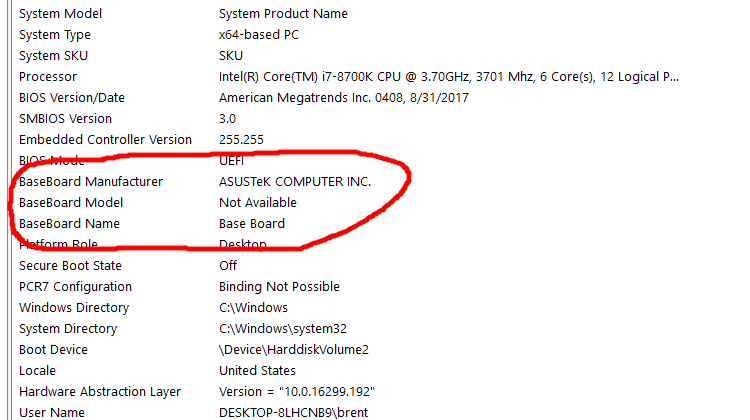
It’s probably not a complete lot to go off of, nevertheless it does no less than let you understand who manufactured your motherboard. And, it might assist make it simpler to discover the data you’re on the lookout for if you open up your laptop to test.
Also Read: What Motherboard Do I Have?
How to Check Your RAM
Checking how a lot RAM you’ve got in your laptop is one other very simple activity. In reality, you’ll find how a lot reminiscence you’ve got on the identical display screen that lists what CPU you’ve got.
Check Your RAM in System > About
- Type ‘about’ in the Windows search bar and hit enter.
- In the System > About menu, you’ll see how a lot RAM you’ve got.

You may learn how a lot RAM you’ve got by wanting in ‘System Information’ on Windows 11 or older as outlined in the part above on how to discover out what kind of motherboard you’ve got.
How to Check Your Storage
There are a few ways in which you should use to test how a lot storage you’ve got and what particular storage gadget is in your PC.
Check How Much Storage Remaining You Have
To see how a lot storage you’ve got, in addition to how a lot cupboard space you’ve got used in your system, do the next.
- Open File Explorer (the folder icon) or kind ‘file’ into the search bar and hit enter.
- Find Local Disk (often C:) on the left-hand menu.
- Right-click Local Disk and hit Properties.

In properties, you’ll be able to see what your system’s whole storage capability is, in addition to how a lot area you’ve used and the way a lot free area you’ve got left.
However, for those who’re wanting to promote your PC and also you need to embody how a lot storage capability your system has, the entire capability listed underneath your drive’s properties goes to be a bit deceptive.
In my case, it exhibits I’ve 1.86TB capability. Obviously, there are not any 1.86TB drives obtainable to buy. Since I do know that I’ve a 2TB drive, I do know that that quantity is off. If I had been going to promote this PC, I wouldn’t say that it has a 1.86TB drive. That would doubtless be complicated to extra educated patrons.
Check Your Storage Device Model Number in Device Manager
To discover out the producer’s listed capability to your storage gadget, you’ll be able to strive utilizing gadget supervisor.
- Type ‘device’ into the Windows search bar and hit enter.
- In Device Manager click on on the arrow subsequent to ‘Disk drives.’
- This will listing your gadget drive, in my case it’s KINGSTON SKC3000D2048G.
- Search for the drive that exhibits up in Device Manager in Google.

In my case, this pulls up outcomes for the KC3000 PCIe 4.0 2TB NVMe M.2 SSD, which I do know is appropriate. This might not work for everybody, however for those who’re having hassle figuring out your particular storage gadget, this might be one of the best ways to accomplish that, exterior of opening up your laptop or laptop computer and checking.
While the strategies above will simply permit you to test your laptop’s specs, you can even use third-party {hardware} monitoring instruments to make it easier to discover crucial information about your system.
We suggest the next instruments to make it easier to monitor you laptop’s efficiency, in addition to provide you with data (like what CPU and GPU you’ve got, in addition to how a lot RAM you’ve got):
- Crucial System Scanner
- CPU-Z
- GPU-Z
- Speccy
- Core Temp (CPU solely)
- HWInfo
- MSI Afterburner
How to Check Specs of A Laptop?
While this submit may appear extra geared in direction of individuals who have desktop computer systems, the strategies outlined above will work for laptop computer homeowners as effectively.
If you’re a laptop computer proprietor and also you’re on the lookout for extra data in your laptop computer’s configuration, take a look at the next information: What Kind of Laptop Do I Have?
After You Check What Computer Specs You Have…
Now that you understand what specs your laptop has you can also make a greater resolution on whether or not or not your present system is value upgrading or not. However, it needs to be famous that if you’re wanting to improve your elements, it isn’t so simple as simply selecting out a brand new and higher part and placing it into your system.
Your current elements will decide which new elements you’ll be able to improve to. For occasion, you probably have an older motherboard, you’ll be able to’t merely exit and improve to the most recent processor, as a result of your motherboard and the most recent processor doubtless aren’t appropriate.
You can also’t exit and improve your graphics card to the largest and best choice obtainable in case your current energy provide doesn’t have sufficient energy provide to accommodate the brand new GPU.
In reality, in quite a lot of circumstances, you probably have an older system, it’d make extra sense to simply purchase or construct a model new system, as your older system may not have any elements value protecting round. If that’s the case, take a look at our purchaser’s information on shopping for/constructing a low-cost PC, or if you need to spend extra, our purchaser’s information on shopping for/constructing a high-end laptop.